Dennis Hackethal, Plagiarist

Dennis Hackethal (DH) self-published the book A Window on Intelligence: The Philosophy of People, Software, and Evolution – and Its Implications in March 2020. Based on my analysis below, I conclude the book plagiarizes Elliot Temple (ET, myself) and David Deutsch (DD, who was ET’s mentor, colleague and friend).

This post provides claims (primarily about plagiarism) along with evidence and reasoning. This allows readers to form their own opinions and conclusions.

This post is about the first edition of the book. It was written before the book's second edition.

Introduction

DH joined ET's online philosophy community in Dec 2018. He left after around 5 months. After leaving, before self-publishing his book, DH participated in negative gossip about ET, including falsely telling people that ET had "insinuated violence" towards DH. Also, after leaving, DH continued reading ET’s writing.

Although the book deals with some of ET's ideas, DH didn't provide any opportunity for pre-publication comment, never informed ET that he was writing a book, did not provide a courtesy copy of the book to ET, and didn't notify ET about the book's existence when it was published. This is after DH paid for calls to learn from ET about topics in the book.

ET wouldn't have helped DH learn if he knew DH was using the help for a book and that ET wouldn't be credited for the ideas he shared with DH. I don't know exactly when DH started planning or writing the book. It usually takes people many years working on philosophy before they have major new ideas to publish. According to his LinkedIn, Hackethal began researching artificial general intelligence less than a year before publishing the book which claims it has "bold new" ideas and "explains the mistakes intelligence researchers have been making – and how to fix them". A year is a short time to learn the field better than other researchers plus write a book.

DH makes many mistakes and didn't seem ready to write a book. But not putting ET's name in the book even once looks intentional. Other people who are less important to the book are named.

Please note that plagiarism can contain errors. I don't endorse the versions of my ideas in the book. I haven't read most of the book.

The parts I comment on in this post were quick and easy to find. I looked at all instances of DD’s name (20), ET’s name (0) and ET’s websites (3), so I know what credit was given to them. I didn’t check whether Karl Popper or others were plagiarized.

Universality

Yellow quotes like this are from DH’s book:

Criterion of universality – x is a universal y if it can do all the z’s all the other y’s can do

This sentence comes from when ET was teaching DH what universality is. One part of the educational help DH got was a discussion involving 20 emails. In it, ET wrote (Feb 2019):

X is a universal Y if it can do any Z that any other Y can do.

DH had trouble understanding. He wrote e.g. “I think I'm still confused about universality.”. ET helped more and DH gained enough confidence to put it in a book. DH didn't give credit for this.

Here’s another example related to universality:

Whichever way one chooses to define domains in which to look for universality, it is crucial to pick useful qualifiers and determine meaningful domains.

This is an important idea that ET explained to DH multiple times because he had difficulty understanding it. The idea is distinctive and is original to ET, not common knowledge. No credit is given.

Plagiarism and Copyright

Plagiarism is taking credit for ideas or writing that isn’t yours. Students fail classes for it. It's considered academic misconduct.

Copyright protects the specific form of a work but not the ideas or concepts. YouTube videos are commonly taken down for copyright violations.

So DH could write about a criterion of universality in his own words and it would only be plagiarism (if he didn’t give credit) but not copyright infringement. But when he uses ET’s words in his book without quoting them or giving credit, then it’s also copyright infringement.

When plagiarism is also copyright infringement, it often provides the most clear-cut, obvious examples of plagiarism. Other examples of plagiarism tend to be more complex and require some understanding of the field, and who developed what ideas, and who got what from what sources, in order to evaluate what is plagiarism. Without a good understanding of a field, it can be hard to understand what a paragraph says or evaluate how similar two ideas are.

Slight rewordings like changing "any Z" to "all the z's" don't prevent copyright infringement when it's still pretty clearly the same sentence.

Copyright has an exception called “fair use”. If DH had quoted ET’s sentence and given ET credit for writing it, then that would be fair use, not a copyright violation, even if ET didn't give permission. Fair use allows using some quotations for critical commentary or educational purposes. However, plagiarism isn't fair use.

Copied Question and Plagiarized Chapter

It is essential to ask, “hard to vary given what constraint?”.

Those quote marks indicate dialog or speech, not a quote from another author. But it’s actually an exact quote from ET, without credit.

I wrote it here (2019-06-01) and more prominently in this blog post (2019-07-17) where I was discussing with Bruce Nielson, an associate of DH who is named in the acknowledgments. Even if I hadn’t told this directly to DH’s associate, we know DH kept reading my blog even after he stopped discussing with me because he uses later material from my blog in his book.

Much of the rest of the chapter is paraphrasing ET without credit, such as this sentence:

We want an implementation to be hard to vary while still solving the problem(s) it purports to solve.

ET has said things like this many times, e.g. a 2011 formulation on the FoR email group:

knowledge is information that is hard to vary while solving the problem [that it’s designed or adapted to solve] equally well or better.

Although DH’s phrasing appears to be based on ET’s writing, much of this concept was originated by DD. DD isn’t credited for it either.

The chapter has endnote 15:

I first came across the idea of using multiplication as an example of knowledge in computer programs here: http://web.archive.org/web/20190701184215/https://curi.us/988-structural-epistemology-introduction-part-1, which is in turn based on the concept of structural epistemology, which goes back to David Deutsch and Kolya Wolf.

On 2018-12-24, after DH verbally said he wanted them, ET emailed DH links to four posts about structural epistemology. The posts supplemented verbal discussion where ET taught DH about it. Here, only one is cited, indirectly, without naming ET, while naming others who are less relevant.

With just this one endnote about one sub-issue, and no mention of ET’s name, DH spends most of ch. 3 explaining ET’s work but presenting it as DH's own ideas. (Some of it, as ET has acknowledged, DD helped with or originated; DH doesn’t credit DD either). DH borrows extensively from ET’s way of teaching and explaining these issues, for a whole chapter, and provides just one endnote mentioning where he got one detail (the idea of using multiplication as an example).

Other ET Endnotes

The easiest way to find more plagiarism of ET is to check the endnotes. There are two more which indirectly reference ET’s website while omitting his name. First:

[33] Hans Hass, “The Human Animal,” as quoted on http://web.archive.org/web/20190702162345/https://curi.us/272-algorithmic-animal-behavior

This endnote doesn't share that ET has made multiple essays and videos about this topic. It's not giving credit to ET for any ideas about animals; it's just using ET as a secondary source to quote Hans Hass. When DH met ET, DH disagreed with ET's position on this topic. ET changed DH's mind via calls, chats, emails, blog posts and videos. ET's views about animals are distinctive and aren't believed by Hass. ET's views are a mix of original and learned from DD.

Unlike ET, Hass gets his name in the main text of the book too, not just in an endnote, as is standard practice.

DH's whole section on ‘Animal “Learning”’ is heavily based on the ideas of ET and DD, including ET’s category of blog posts about animal intelligence. I think it's primarily based on ET's work since DD has little public material on this topic.

We can explain this easily and well through the existence of an inborn pathfinding algorithm whose results just need to be stored in memory for later retrieval.

DH learned about pathfinding algorithms from ET on a call. DH argued the other side (that pets navigating rooms indicates creativity) until ET taught him better ideas. It's interesting that DH uses the word "easily" since he was unable to figure it out himself. I personally was able to think of that point myself without being told, but DH wasn't. He's presenting himself as someone he's not.

Before learning from ET, DH actually had conventional/mainstream views about animal intelligence. No credit is given for radically changing DH’s conclusions on these matters and teaching him the viewpoint the book advocates shortly before the book was published.

The last endnote related to ET is:

[36] As far as I am aware, the notion of such a meta-algorithm was first introduced in the form of a “fail-safe” (but its significance underestimated) here: http://web.archive.org/web/20200207181124/http://curi.us/2245-discussion-about-animal-rights-and-popper

This includes an unargued, unexplained, unreasonable claim that ET made a mistake! ET’s knowledge of an obscure subject is not evidence that ET underestimates it. ET bringing up something original (as DH believes it to be) is not evidence that he didn't realize it’s significant.

Again ET’s name isn’t given and this is only an endnote so a reader could easily never realize that even this little bit of partial credit was given. DH uses the term “meta-algorithm” 95 times in the book, inspired by ET, but doesn’t give ET meaningful credit. I actually think DH is confused about the issue and its originality (it’s already in widespread use by programmers, which DH apparently hasn’t noticed, but certain applications of it about animals are original to DD and ET), but I won’t get into that.

Note that the link here goes to a post ET wrote in Nov 2019, over six months after DH had left ET's online community. This shows that after DH left, he was still reading ET’s work and using it for his book, including specifically ET’s posts related to animal intelligence.

Another plagiarism example is DH’s discussion of golden rice and the precautionary principle. ET wrote about golden rice and the precautionary principle, also in Nov 2019 while DH was reading ET’s work and writing his book. That ET post also explains a non-standard view of Pascal’s Wager, and DH wrote something similar about Pascal’s Wager in another part of the book.

DD Plagiarism

I skimmed DH’s book and noted a few topics discussed which are distinctively associated with DD. Then I searched for every time DD’s name was used to give DD credit. Subtracting what DD got credit for from the list, the rest are plagiarism.

Topics plagiarized from DD include: Problems are soluble, problems are inevitable, various universality stuff including the jump to universality (using DD’s exact phrase "jump to universality” seven times), reach, and criteria for reality. These are major ideas from DD’s books, especially The Beginning of Infinity (BoI). They are highly original and distinctive ideas which DH gives no credit for. DH’s book title “A Window on Intelligence” is also based on DD’s chapter title “A Window on Infinity” in BoI.

Topics where DD got some credit include: Structural epistemology, hard to vary, universal explainers, static and dynamic memes, Church-Turing-Deutsch principle, and "If you can’t program it, you haven’t understood it.”. In the first 3 of those 6 cases, DD’s name only appears in an endnote, not in the main text of the book, so most readers won’t know it’s DD’s idea. Also there’s no text crediting DD for the Church-Turing-Deutsch principle; that's just implied by DD’s name being in the principle’s name. "Deutsch" is a pretty common name and there’s no mention that it’s the same person and no citation to DD’s book, BoI, where DD talks about is as the “Church-Turing conjecture”.

There’s also an endnote linking to a DD blog post. I didn’t read that part of the book to investigate further.

The appropriate way to handle this, at minimum, is to credit DD by name in the main text each time one of DD’s major, original ideas is first introduced. I should be treated that way too.

As a comparison, in The Fabric of Reality (FoR) DD shares a few criticisms of Thomas Kuhn, who is a relatively minor topic (the index indicates that Kuhn comes up on only 11 pages in a 22 page section of the book, and isn’t mentioned at all elsewhere). Nevertheless, Kuhn’s name is used 26 times, while DD’s name is only used 20 times in DH’s whole book, even though DD and I (DD's former student who has a lot of similar ideas) are basically the theme of DH's whole book. (DD’s book is around 40% longer than DH’s, but I don't think that makes much difference since Kuhn only comes up in one part.)

Misrepresenting Association with DD

From the acknowledgements with my italics:

David Deutsch, whose books were some of the inspirations for this book, for tirelessly answering my many questions over the years.

That isn’t true. I have information about this from both DD and DH. Around a year before DH published his book, my impression was that he'd had one conversation with DD years earlier. Then DH asked me about DD's contact information.

Feynman the Popperian

Feynman was familiar with Popperian philosophy and even taught it (though not without mistakes).

Source: Me?

As far as I know, I'm the only person to publicly claim that Feynman was familiar with Popper (until DD joined an online discussion to back me up). Unlike DH, I gave sources and evidence for this claim since it's not common knowledge and most people would probably deny it.

I figured it out from Feynman’s books but DD already knew it from talking with Feynman in person and also from his knowledge of the physics community. I shared the idea and many people thought I was an idiot until I convinced DD to share part of his knowledge too.

As far as Feynman teaching Popperian philosophy, that’s a misleading exaggeration. And, despite being the source of the idea of Feynman's familiarity with Popper, I don’t know what mistakes DH is accusing Feynman of making (he doesn’t explain or give any source).

Sources: I have a blog post Feynman the Popperian from 2008 and there was more at email discussion groups. Yahoo Groups has been shut down now so I'm not providing a link, although I do still have the emails.

I also told DH about this directly, e.g. from 2018-03-03 I told him “i think Feynman read and understood Popper well.”

Here’s part of DD's post to the FoR group, on 2011-05-02, responding to one of my critics. The quote DD responds to is cut from the middle of a paragraph in a rant directed against me:

On 2 May 2011, at 3:41pm, John Clark wrote:

There is in fact no hard evidence that Feynman even knew that a fellow by the name of Karl Popper ever existed.

For what it's worth, I happened to mention Popper in the one conversation I had with Feynman, sometime in the 80s, and he did not say "who's that?" but replied meaningfully to the point. So that's evidence he had heard of Popper at that time. What he knew of him, I have no empirical evidence of, because Popper was peripheral to the conversation and I never got round to pursuing the matter.

DD told me personally what he and Feynman said to each other. DD and I both believe that conversation showed that Feynman knew a lot about Popper.

DH Doesn't Know How to Cite

[6] Karl Popper, “Back to the Presocratics”

[10] Karl Popper’s translation in “Back to the Presocratics”

These citations do not follow any of the standard style guidelines for cites. Nor, worse, do they provide enough information for someone to find what Popper wrote. DH gives the name of an essay without saying what it is (book, essay, TV show, etc.) or saying what book it can be found in. DH elsewhere cites books and TV shows using the same format (quote marks around the title) that he here uses for citing an article within an unnamed book. In those cases, at least he’s giving an author and the overall title of the thing in question, so it’s less bad. Here he left out the name of the book he’s citing!

DH even screws up referring to his own writing:

Dennis Hackethal, Misconceptions About Evolution, 2020

Dennis Hackethal, What Is the Difference Between a Person and a Recording of That Person?, 2020

What book, journal or website has those articles? All DH gives is a title but no link or indication of what type of work they are. It’s not enough information to look them up and read them.

People who don’t know how to cite – and are unable or unwilling to learn or to use a tool that creates properly formatted citations for you – should not be writing books with 86 end notes and 35 bibliography entries.

DH's Unprofessional Insults

Although large portions of the book are about DD’s ideas, Nick Bostrom, who is brought up as a target to attack (not as a source of ideas DH advocates), is named more times than DD. Here’s a sample of what DH says about Bostrom and his book Superintelligence:

Oxford has produced … some of the worst [intelligence research] (Nick Bostrom).

Bostrom is [a] slave of [irrational ideas]

[Bostrom’s] book is such a nauseatingly pessimistic attempt to snuff out AGI

[Bostrom’s] book is a slaveholder’s manual. To say this is not an exaggeration, nor is it metaphorical

[Bostrom’s book is a] Gestapo-style manual

DH does give some intellectual reasoning related to these attacks. I think the reasons are partially right but I also disagree significantly. The reasoning is unfair to Bostrom and would be inadequate to make these attacks even if DH was right about all the issues. If you read the book to see the context of the Bostrom quotes and understand the arguments, you may agree with DH’s claims somewhat more, but you won’t find the quotes any nicer.

Lots of the reasoning DH uses for attacking Bostrom on AI alignment and slavery is plagiarized from ET and DD. DH also plagiarized the view of a new AGI as similar to a child needing an education. Comments like “If you build an AGI, you are a parent.” appear to be taken from ET. Note that although the AGI material is easily recognizable and distinctive, it's also changed and wrong. No, building an AGI doesn't automatically make you a parent.

The issue of introducing errors to plagiarized ideas comes up on other topics too. Being an author is hard and it takes skill to figure out what should and shouldn't be cited (which involves judging whether ideas are original, important, distinctive and more). It's tricky to correctly state what others said or thought and give them credit while being careful not to attribute any of your own errors or changes to other people. However, since ET's name is in the book zero times, and the book treats other intellectuals very differently, it doesn't look like a case of DH doing his best to give ET credit but making mistakes.

Elsewhere, DH also brings up parenting to talk about it being an area heavy with static memes, which is again something he learned about from ET.

Richard Dawkins

DH struggles to make accurate statements about what other thinkers besides ET believe, although he does tend to name and credit them, not present the ideas as his own:

the evolutionary biologist Richard Dawkins discovered that organisms are protective shields genes build around themselves. Organisms are the slaves that genes use to spread through the population.

and

Like all organisms, human bodies are the slaves that genes use to achieve this purpose.

The term is “survival machine” (which appears 96 times in Dawkins’ book, The Selfish Gene) not "protective shield". I still remember the "survival machine" term many years after reading the book because it was a major theme and heavily repeated. Why doesn't DH use the right term? The term “shield” is only in the book once in a different context (DNA membranes). Dawkins’ term is more accurate and descriptive, and somewhat different (a machine does more than a shield, e.g. machines have moving parts and could plausibly hunt for food, while shields don’t).

The stuff about slavery is confused and problematic. It's a poor explanation of survival machines that's being unfairly associated with Dawkins, who never said it. To make it harder to tell that Dawkins never said it, DH gives no cite here and never specifies which of Dawkins’ books he’s talking about.

Dennis Hackethal’s Comments

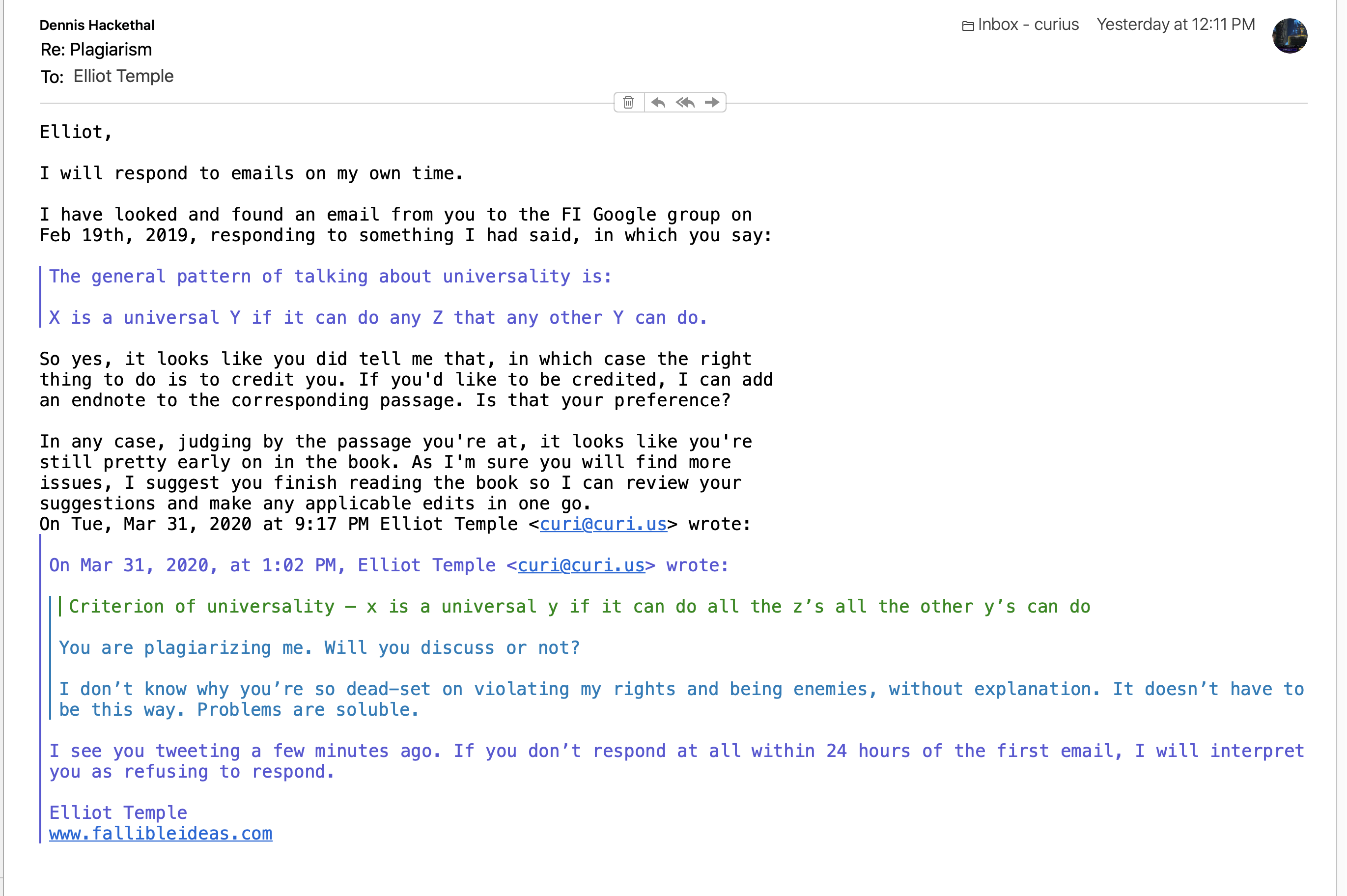
I contacted DH and brought up concerns about plagiarism when I first saw a major issue in the book: the criterion of universality sentence. He replied with what I thought was an admission of some plagiarism (yellow quotes are now from DH's emails):

yes, it looks like you did tell me that [sentence], in which case the right thing to do is to credit you.

DH then proposed adding an endnote with no mention of adding ET's name to the book or changing the sentence to use quotation marks.

judging by the passage you're at, it looks like you're still pretty early on in the book. As I'm sure you will find more issues

After I thought he acknowledged I was correct about the plagiarism I brought up, I read this as an admission that the book probably contained more plagiarism.

I suggest you finish reading the book so I can review your suggestions and make any applicable edits in one go.

I read this as DH having no plans to fix the "more issues" he was "sure" were present unless I found them for him. If he'd written the book carefully and was confident he knew how to avoid plagiarism, then I wouldn't expect him to be "sure" there were "more issues". If he isn't confident in the rest of the book, then he ought to review it and fix it himself, or if he doesn't know how to do that or doesn't want to, then withdraw it from sale.

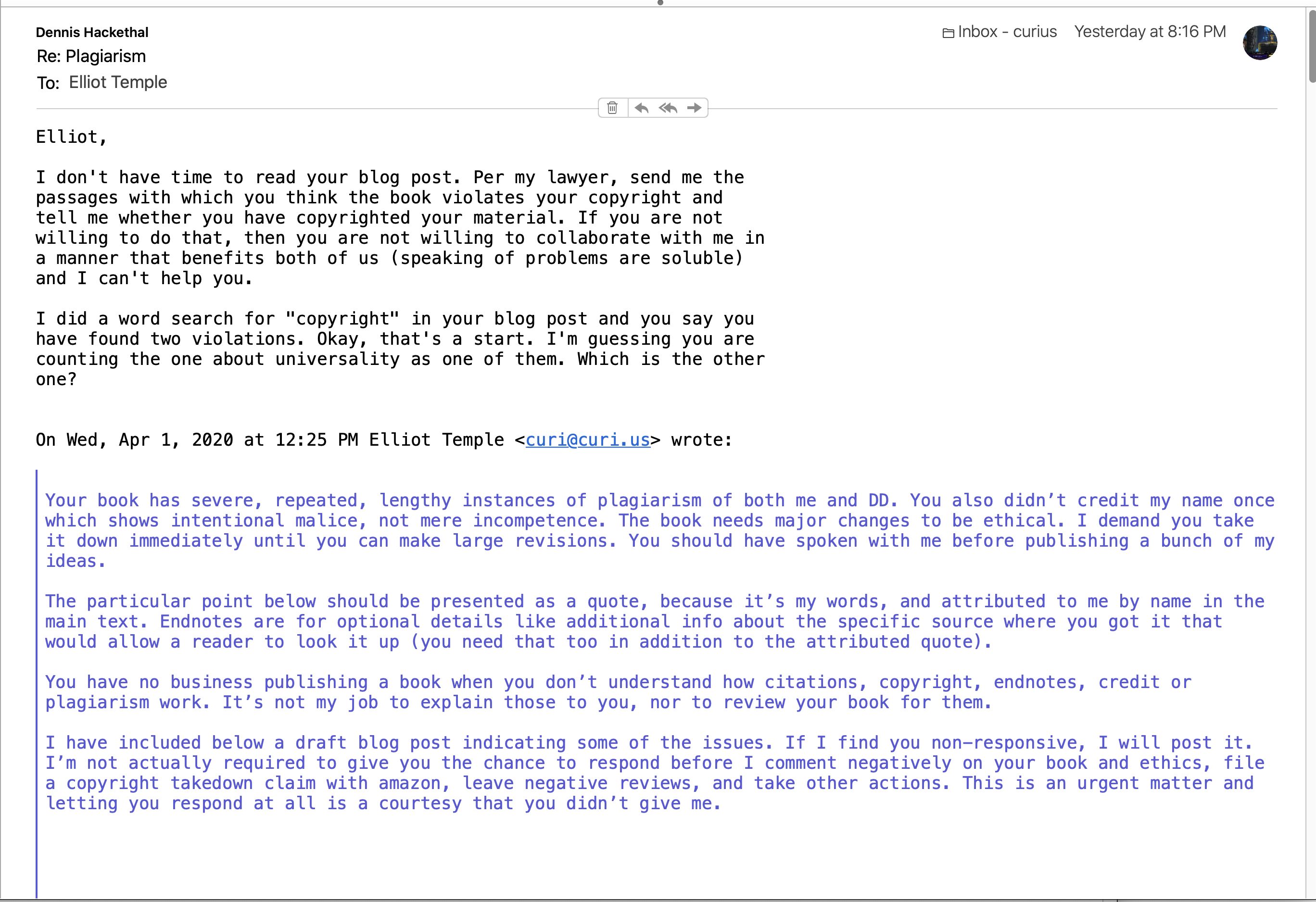
Since he wanted one long email, I sent DH a draft of this blog post. He replied:

I don't have time to read your blog post.

That seemed unreasonable to me after he had asked for one long email. I took it as him knowing he was in the wrong, having no objections to my post, and deciding to just strategically ignore me and my plagiarism complaint. I thought that he believed he could get away with plagiarizing me, and all I would do about it was write a blog post, which he could ignore, and that was worth it to him.

He also brought up his lawyer and changed the subject to copyright, not plagiarism. I replied:

You only replied about copyright. Are you saying you’re unwilling to address plagiarism issues?

DH did not reply so, given that he was ignoring me, admitted to some problems, and offered no objections to my post, I went ahead and published my post. He didn't tell me there was a problem until 2024, when he claimed that he was actually extremely upset in 2020. That implies his 2020 communications and his years of silence were misleading: it wasn't really a matter of not having time like he told me.

Here are screenshots of DH’s emails: email 1 and email 2.

DDoS

In 2020, my blog, curi.us, was DDoSed for the first time around 45 hours after I sent my draft post about plagiarism to DH, before I published it. DDoSing is a crime involving breaking websites by sending malicious information to them over the internet.

Based on the timing, I suspected the DDoS was connected with this blog post. I had questions for DH but he remained silent.

In 2024, after four years of silence, DH told me "For clarity: my denial of all criminal allegations means I did not DoS your website, nor do I know anyone who did." (I didn't call him a criminal.) He wants me to consider him a non-suspect because he belatedly said he didn't do it, even though he still won't discuss it and answer questions. And, assuming he doesn't know who did it, I don't understand how he could be confident that the perpetrator isn't someone he knows (like Andy B, who left hundreds of harassing comments on my blog).

Editing Pass

This blog post was first published on 2020-04-03. You're reading it after an editing pass in 2025. This post is still about the first edition of the book. I don't consider the second edition satisfactory, but the first edition remains relevant anyway. It was published, people own it, and DH is still defending the first edition. DH also hasn't announced or explained the second edition or provided a change log or errata, and he didn't make reasonable efforts to distribute the second edition to readers (for example, he delayed sending the update to people who'd already bought the book on Kindle for four or five years). People with a paper first edition have no way to know about any changes since Hackethal made no announcement, and anyone who already read a first edition ebook is unlikely to notice the second edition even if their copy eventually updated.

Why edit this post? The original was written quickly, with no attempt to be comprehensive, partly because I didn't want to be DH's unpaid book editor. I was unhappy about being plagiarized. Some of my rude comments were unnecessary to my main point about plagiarism. DH didn't tell me until years later that he thought this post wronged him. When I found out that he was upset, I offered to make changes, but DH declined, saying he wanted me to completely delete everything I ever wrote about him and agree to many other demands too. His threat to sue me got in the way of making changes, but I've decided to edit it anyway. It's now closer to how I'd write it today.

This version is heavily based on the original post. I made larger changes to the start and end, but smaller changes in the middle. I mostly left the same criticisms of the book in the same order. I didn't review the book to find additional concerns. I've kept this as an improved version of the original post, so I've mostly left out events from after 2020.

Conclusion

I think Dennis Hackethal's book plagiarized Elliot Temple and David Deutsch. Based on a quick review, I found problems with the book which I've shared above. Because I gave evidence and reasons, not just an assertion, you can form your own opinions and conclusions.

I request that Hackethal fix the book, share errata or some other explanation about the fixes, and make an announcement so people know about the changes – or else stop selling it. I also request that Hackethal stop reading my philosophy essays and watching my philosophy videos in order to help prevent future plagiarism.

2025 Updates

Hackethal's website, Veritula, does worse than plagiarize me. It uses my ideas but falsely attributes them to Karl Popper. He also made legal threats and attacked me online. I made a timeline.


Elliot Temple | Permalink | Messages (28)

Review of My Quotation Accuracy

In the last few months, Dennis Hackethal did an extensive review of my writing and wrote a large amount about me. One thing he did was look for misquotes. His attitude to misquotes has similarities to mine. It looks like he may have been inspired by me, but he doesn't credit me and he's pedantic in ways I disagree with.

If I misquoted, I'd want to know. But I'm happy to report he was unable to find a single error in my quotations.

I thought I was doing a good job with my quotations, even in informal contexts, but it's nice for an independent third party to spend unpaid hours validating this. And he's hostile towards me, so I'm not worried that he's holding back criticism to be nice. However, a potential source of error for the review is that he doesn't understand misquotes very well (see below); maybe a smarter reviewer would have found errors.

He claimed to have found errors for 15 quotes and called my results "terrible", but none are actually errors. For each quote, he presented specific information about what errors he's alleging. He didn't claim that I got a single word wrong. Instead, he was pedantic.

Most of the "... misquotes ..." are just that I often don't put an ellipsis at the start or end of a quote (see how weird it looks earlier in this sentence?). That's an intentional style choice which is widely used. Style guides have varied guidelines about this topic, but I don't know of any that agree with Hackethal's view that you always need starting and ending ellipses when quotes start or end mid-sentence. Those ellipses are commonly discouraged. On his website he recommends following style guides, seemingly unaware that they disagree with him.

To be thorough, here are more details covering all the other alleged errors. Sometimes emails or PDFs have mid-sentence line breaks which I fix. Also, I once clearly labelled a quote of song lyrics as abridged and linked the full lyrics, but he's calling that an error because I didn't individually indicate every abridgment within the quote. And once, when writing in plain text, I didn't include italics in a quote because that isn't supported by the plain text format. I was writing an email to people who I expected to be unfamiliar with internet norms and modern technology, and I wanted to keep it short and avoid confusing them, so I did it that way on purpose. Also, I quoted a dictionary as saying "the" even though the website for a different dictionary says "The" with a capital letter (Hackethal apparently confused the dictionaries). I copy/pasted my quote from the Mac Dictionary app, which has a lower case letter; I didn't change the capitalization.

So the review of my use of quotations didn't find any mistakes, only intentional style choices (mostly omitting ellipses at the start or end of quotes).

Update 2025-03-18: An error has been brought to my attention which I've corrected. I wrote "on the dictionary's website it says "The" with a capital letter", but I was wrong. I didn't carefully double check all of Hackethal's claims and repeated one of his errors. I didn't notice that he linked a web definition from the wrong dictionary: The Oxford Dictionary of Phrase and Fable. The webpage for the correct dictionary doesn't make the definition publicly available. The print version of New Oxford American Dictionary, like the Mac version and my quote, has lowercase "the". Thank you for the correction to my alert reader who says he wishes to remain anonymous out of fear of being targeted by Hackethal.


Elliot Temple | Permalink | Messages (0)

Responses to Dennis Hackethal about Crime and Threats

Dennis Hackethal posted five blog posts attacking me. Here's my main response. I didn't read much of them because they're very long (over 36,000 words, around 100 pages) and unpleasant. I skimmed some and saw errors and insults. However, someone showed me two important parts, related to crime and threats, that Hackethal should have told me but didn't. So I'll address those parts.

In general, the posts have lots of stuff that Hackethal didn't say before. Instead of telling me his complaints, he refused to tell me even after I asked, then he blogged stuff that he wouldn't tell me. If there are other things I should know, I may have missed them, and Hackethal or his lawyers should email them to me.

I Didn't Call Dennis Hackethal a Criminal

Hackethal claims I called him a criminal. That was never my intention, and I don't think I did it. Hackethal's lawyers brought it up too but wouldn't tell me what statements they were referring to. I offered to take it down if they'd provide specifics, but they didn't. They did send me a list of 23 links with some quotes, but they didn't specify that they thought any of those statements called him a criminal. They said things like "Remove this article entirely [...]" and "Remove any mention of Mr Hackethal on that page [...]".

Now, on his blog, Hackethal has been specific. After reading the quotes he gave, I don't think any of them called him a criminal. I think he's making mistakes at reading comprehension and logic.

I've taken down the majority of the statements Hackethal pointed out for this topic because they aren't important enough to me to argue over (many were in blog comments, not posts) and I've only just now found out how he was (mis)reading them. If Hackethal had emailed me years ago, I would have addressed this then.

I left some statements up but I'm willing to make clarifying changes. However, I want Hackethal's consent so he doesn't try to sue me for rewordings that I did to try to satisfy him.

Misquotes

While reading quotes Hackethal gave, I noticed he misquoted me. I'll use variables to show the structure.

With two separate quotes, he quoted me as saying "A [...]" when I said "A or B", which is misleading.

He quoted me as saying "I only A due to [among other things] F." I actually wrote "I only A due to B and C (including D, E, and F)." F was a parenthetical sub-point of C, not my reason. And "among other things" means that more unmentioned things exist, but I didn't say that. It's an inaccurate paraphrase of the text it replaced, "B and C (including D, E, and".

So I warn people against trusting facts or quotes in Hackethal's posts.

Removals

I've also removed some other things that Hackethal has now complained about. He should have just told me his complaints instead of writing long attacks. One was a guest blog post about some people, including Hackethal, who stopped discussing with my community. The goal was to post mortem what happened and improve discussion, but Hackethal didn't like it. I also removed my comments about an old David Deutsch interview and a screenshot of a tweet to Deutsch.

Hackethal is sharing copies but I've removed the originals. With the guest blog post, in 2020, someone complained that it included email addresses (that people had used as their public forum usernames). Although I think attributing quotes to the usernames that publicly posted them is reasonable, and those usernames are publicly available on the Google Groups website, I removed them from the post. I've tried to be responsive to complaints. Today, Hackethal is sharing an old copy of the post from 2020 that includes email addresses, against the wishes of me and others. It seems kind of contradictory that he wants me to remove things but he shares old copies.

In my primary letter to Hackethal's lawyer, I tried to tell them about my negotiating position, including sharing information about what statements were and weren't important to me to keep up. But I received no reply and Hackethal's posts appear to largely ignore my letter.

Disavowing Threats

I didn't know this until now, but in 2021, a commenter on Hackethal's blog, "Connor", complained about Hackethal plagiarizing me, said something threatening about attacking Hackethal's face with a baseball bat, and said Hackethal should kill himself. As far as I know, I've never communicated with this Connor and they've never posted at any of my websites. Hackethal brings up questions about how I would handle this. I don't want my readers to do this, and I'd prefer if someone had told me sooner. Hackethal suggests that silence, neutrality and not taking sides would be acceptable responses from me, which may explain why he didn't report the harassment to me. I disagree with that viewpoint.

I disavow Connor's posts, and I ask my readers not to threaten anyone with violence. Connor is now banned from making accounts or writing anything at my websites. I'd also block Connor on social media if I saw him. Connor's comments are unacceptable and I regard anyone writing similar comments as working against me, not helping me.

Besides the usual reasons it's bad, threatening violence is also bad regarding fallibilism and rationality. Violence can't be retracted like arguments. And what if you intimidated someone into silence who was actually correct? You'd stay incorrect. People like Connor are unsafe to have around: if he got into a debate on my forum he might post threats. When you see someone attack an out-group member over a disagreement, they're revealing that they may attack an in-group member over a disagreement too. That's a particular concern at communities with diversity of thought.


Elliot Temple | Permalink | Messages (0)

Dennis Hackethal Threatened to Sue Me; Now He's Blogging about Me

Recently, Dennis Hackethal wrote five blog posts and some tweets disparaging me. Last year, his lawyers threatened me with a defamation lawsuit. They wanted me to take down everything I ever said about Hackethal, most of which is old (2018-2020). He'd never before said he wanted anything removed. They refused my offer to discuss or negotiate, ignored my offer to make corrections if they pointed out any mistakes in specific statements, and sent an all-or-nothing ultimatum with 20 demands (many unreasonable). I declined.

I wrote a long letter to Hackethal's lawyers which explained my position, reiterated my offer to negotiate, and pointed out some of their errors. I received no response. Then Hackethal started publicly attacking me eight months later (and attacking multiple other people who've had online discussions with me). Although the issues are mostly around five years old, the attacks contain a lot of new information that he didn't say before. He says that he won't discuss or negotiate and the only way he'll stop attacking me is if I unilaterally give in to all of his demands. He's rejected diplomacy, and barely communicated, for five years now.

It's legal to make true statements (or to express opinions). I've given reasoning and evidence for my statements. I've offered to correct errors but Hackethal hasn't told me errors with specific statements. Hackethal is also accusing me of saying things that I don't think I said. I'm willing to make clarifications but he hasn't asked for any. He wants me to take down statements without him ever having to give specific reasons that they're false. He's attacking my free speech rights.

Hackethal's Complaints

One of Hackethal's main complaints is that, in 2020, I wrote a negative review of his book, which I said plagiarized me. I emailed him about my concerns before publishing them. Regarding an example I thought was plagiarism, he replied: "So yes, it looks like you did tell me that, in which case the right thing to do is to credit you." He asked me to send him the rest of my issues with his book as one long email, so I sent many issues at once (5,000 words), but he said he didn't have time to read my email. Then he stopped answering my emails and didn't communicate with me again for four years. He offered no objection or criticism about my claims, he didn't ask me not to post them, he didn't say he thought they were false or illegal, and he didn't want to discuss them, so I published them. I thought he believed in free speech and critical discussion. I didn't know that he wanted my post taken down until I received a letter from his lawyers four years later. I still haven't received specific information pointing out a false statement in my post.

Hackethal's lengthy blog posts (over 36,000 words, around 100 pages) bring up many other complaints of varying relevance. Some were already covered in my main letter to his lawyers, which he hasn't answered. Some have little to do with his legal rights. For example, he accuses me of making mistakes with 15 quotations (but he's wrong 15 times).

I addressed more of Hackethal's complaints here. I'm not trying to respond to everything he said (I only skimmed most of it). I'm focusing on issues I think are important.

20 Demands

In my letters to Hackethal's lawyers, I offered to negotiate and separately offered to correct errors in my posts without asking for anything in return. I also said I was open to rewording my claims to be gentler. They said they wouldn't discuss it, never tried to tell me errors in specific statements, and gave me an ultimatum: accept their list of 20 demands (with no option to change any of them or add any demands of my own) or they might sue me. I declined.

Some of the 20 terms are unreasonable. For example, they demand that I remove "each and every published statement that Temple has made about Hackethal" including "both public and private publication". That includes removing statements which aren't even alleged to be defamatory.

Another term demands that I publish a retraction, exactly as they wrote it, while presenting it as my own words and keeping the terms confidential. Putting a post on my blog that I didn't write, and pretending I did write it, would be plagiarism. Ironically, Dennis Hackethal demanded that I plagiarize the words "[...] Dennis is not a plagiarist [...]". I don't think he understands what plagiarism is.

Another term said the terms would be treated as though I had equal 50% participation in writing them. But they didn't let me participate in writing the terms.

Another term demanded that I waive my legal rights regarding anything Hackethal's done in the past, including any illegal actions he's done that I don't know about.

Here's how Hackethal presents this in his primary blog post:

Next, my lawyers had to send Temple a cease and desist for defamation (then he suddenly wanted mediation). When they offered him a mutual non-disparagement agreement, he declined.

This is misleading. He doesn't say that I declined an all-or-nothing list of 20 demands. He doesn't say that I offered to negotiate but they declined. It's factually false that I "wanted mediation". Considering that Hackethal hadn’t tried asking me for any removals, I disagree that his lawyers "had to" send me a letter. And he doesn't say that the agreement contained no terms to prevent plagiarism. Criticizing plagiarism is disparagement but plagiarizing me isn't disparagement. Plagiarism is generally legal, so my main defensive option is to write about it, but the agreement would silence me while allowing Hackethal to plagiarize me. So I advise against trusting what Hackethal says about me and these events.

Defamation

Hackethal threatened to sue me for defamation. To win that lawsuit, he'd have to show multiple things including that my statements are false, are damaging, and aren't matters of opinion.

Are my statements false? When I first published my statements about plagiarism, I included details, quotes, evidence and arguments. Hackethal hasn't tried to tell me refutations of my statements. He seems to think I should withdraw my statements without ever seeing evidence or arguments showing that they're false. Laws have been written to protect the free speech of critics. Law professor David Hudson's article Defamation and the First Amendment says "Generally, the plaintiff [which would be Hackethal] bears the burden of proof of establishing falsity."

Are some of my statements about matters of opinion? You can imagine a hypothetical scenario where potential plagiarism is in a borderline gray area where reasonable people could disagree about whether it is or isn't plagiarism. For reasonably debatable issues and open controversies where there's no definitively correct answer, people are free to form their own opinions about the correct conclusion, since their opinion can't be proven false. For Hackethal to win in court, Hudson says "The statements in question must be objectively verifiable as false statements of fact. This means the statements must be provable as false."

Rejecting Diplomacy

Hackethal's blog says he will keep taking actions against me until I unilaterally agree to his 20 demands. He says he won't talk with me or negotiate.

He also offered to give other people money to pursue legal complaints against me. If anyone has a complaint, please email me instead of escalating to lawyers before attempting conflict resolution.

Hackethal issued a no contact request to me and anyone associated with me. He says "Don’t cause third parties to talk to me." which suggests that no one may attempt diplomacy with anyone he knows, and suggests none of us may write blog posts related to this conflict because those could lead to someone saying something to him. His broad wording also implies that I'm unwelcome to contact his lawyers, who ghosted me anyway.

Was Hackethal ever willing to have a diplomatic discussion? In 2024, he emailed me saying he wanted conflict resolution. I sent him six emails in that conversation but couldn't get him to summarize his side of the story. He refused to respond to my blog posts from 2020 explaining my side of the story. He told me for the first time that he was unhappy with my book review but I couldn't get useful details. He said that "irrespective of what has happened" he hoped "we can move on, get the acrimony behind us" – so I was surprised when, a month later, his lawyers contacted me. It turns out he was already researching lawsuits a month before that conversation, so I'm skeptical that the conversation was in good faith.

Error Correction

I've always been willing to discuss complaints and correct errors on my websites. People can just email me. Hackethal hired lawyers instead of telling me what he wanted, and now he's trying to harm my reputation rather than discuss our conflict.

It seems unfair for him to try to pressure me into taking down claims while he's refusing to discuss whether they're true. If my claims are true (or are reasonable opinions), then I should be allowed to say them. If someone did plagiarize me, then I should be able to explain my side of the story. If I think someone is a jerk to me, I should be able to complain (using truths and reasonable opinions).

I'm also reluctant to edit old posts without Hackethal's consent because I don't know what wordings he'd prefer and he's shown no interest in wording changes (instead demanding full removal). He's actually complained about a "softer", less opinionated wording.

Hackethal doesn't have an error correction policy like mine, stopped responding to me when I tried to tell him errors in 2020, and now has told me not to contact him (which includes not reporting errors to him). This post pointed out a few of his errors, and I'd be willing to point out more errors if he were open to discussion and error correction. I believe his posts are defamatory and I request they be taken down (or thoroughly corrected).

Call For Help

If anyone wants to help me deal with Hackethal, contribute to my legal defense fund, or provide relevant information, please email me at curi@curi.us


Elliot Temple | Permalink | Messages (0)

Timeline of Dennis Hackethal Using My Ideas without Crediting Me

Dennis Hackethal created a website, Veritula, based on my Critical Fallibilism (CF) philosophy, where he writes frequently about CF ideas. But he didn't credit me for my ideas. Instead, he falsely attributed my ideas to Karl Popper, which denies me credit, implies that I plagiarized Popper, confuses people about Popper's views and implies that other people, like Popperian author David Deutsch, misunderstood Popper. He's also written long attacks on me and made legal threats. Here's a timeline:

In 2018, Hackethal came to me as a student. He paid for me to personally teach him on calls. He joined my email discussion forum and chatroom. He tried to learn philosophy from me.

In 2019, Hackethal formed a lasting grudge against me. I believe it's because he saw himself as a very smart expert, and he wanted to be my friend and colleague, but he felt rejected by me. I removed him from a non-public chatroom because he was getting upset and I thought he would do better with slower-paced email discussions.

In 2020, Hackethal self-published a book, A Window on Intelligence: The Philosophy of People, Software, and Evolution – and Its Implications. I wrote a post saying it plagiarized me and David Deutsch. He hadn't disclosed that he was writing a book. I saw him as a beginner who was many years away from being able to write a good book, and the book didn't change my mind about that.

In 2020, regarding a sentence I said was plagiarized, Hackethal said "So yes, it looks like you did tell me that, in which case the right thing to do is to credit you.", then he refused to discuss more. Although I sent him a pre-publication draft of my blog post about plagiarism, he offered no objection to what I wrote, didn't deny plagiarizing me, and implied that he didn't care what I said and could get away with ignoring my complaints. Previously he'd told me, about himself, "It’s really hard to offend me." He also said he valued free speech and strong criticism.

In 2020, someone DDoSed my website shortly after I sent Hackethal the draft accusing him of plagiarism, before I published it.

In 2024, he stopped ignoring me. From his lawyers, I found out that he was really upset. He claimed I had wronged him. His lawyers tried to bully me into signing a 20-term contract requiring me to take down my plagiarism accusation and never say anything negative about Hackethal. They said his book didn't contain plagiarism but were unwilling to discuss it. They asked me to a sign a contract that would prohibit me from pointing it out if he ever plagiarized me in the future, but which had no terms to discourage plagiarism. I declined but offered to negotiate. He wouldn't negotiate or participate in mediation, but also didn't follow through on his threat to sue me; he and his lawyers just went silent.

In 2024, Hackethal created a website, Veritula, which I believe uses my Critical Fallibilism ideas without crediting me.

In 2025, eight months after having his lawyers ghost me, he publicly escalated, even though I hadn't written about him for years. He published long blog posts attacking and lying about me (over 35,000 words).

I didn't respond immediately to the blog attacks and Hackethal complained about the lack of response and kept attacking me. Then I responded and he complained that I had responded and kept attacking me. Then I didn't respond for seven months and he kept attacking me.

After rereading old chat logs where I said I don't share my photo online because I want privacy, he published photos of me (which he did not get from me) while calling me dangerous.

I didn't notice Veritula existed until after Hackethal attacked me in 2025. In recent weeks, Hackethal has written a lot more on Veritula without crediting me.

After my 2020 blog post about Hackethal's book, I didn't write a blog post about him again until early 2025 when I responded to his posts attacking me. Then, although he was trying to ruin my reputation, I tried to go back to ignoring him.

I'm responding now because I believe Veritula is extensively using my best ideas without crediting me. Also, showing restraint and being silent about many provocations failed to deescalate the situation.

I was surprised when Hackethal started attacking me after a four year break. Now I can see a potential purpose to the attacks: discrediting me makes it easier to use my ideas without attributing them to me. Turning people against me can prevent them from listening to my concerns. Slinging mud can muddy the waters and distract from intellectual issues like attribution.

Hackethal says I'm a cult leader, but he won't stay away from my philosophy ideas, which he seems to think are the world's best. He hired me to help him learn philosophy. I believe he's using CF ideas (without crediting CF) for Veritula in preference to Popper's or Deutsch's ideas. He had a grudge against me before my first public complaint about him, and he still has it six years later; he needs to get over it, leave me alone, stop studying my philosophy articles, and cite his sources.

More posts related to Hackethal:


Elliot Temple | Permalink | Messages (0)

Dennis Hackethal's Website, Veritula, Is Worse than Plagiarism

Dennis Hackethal created a website, Veritula, based on my philosophy, Critical Fallibilism (CF). He explains and uses CF ideas but, instead of crediting the ideas to me or CF, he credits them (without evidence or citations) to Karl Popper's philosophy, Critical Rationalism. This is quintuply problematic:

  • He's using my ideas without giving me credit.
  • He's implicitly accusing me of plagiarizing Karl Popper.
  • He's spreading misinformation about what Popper's views were.
  • The misinformation attributes ideas to Popper that many people see as weird, bad or false.
  • He's implying that David Deutsch and other Popperians misunderstood Popper, without giving evidence, quotations or citations.

Extensively using CF ideas and misattributing them to Popper is worse than plagiarism. In addition to using my ideas without crediting me (the same harm plagiarism does), he's also implying that I'm a plagiarist, implying that other people misunderstood Popper, confusing people about Popper's views, and falsely attributing unpopular ideas to Popper (extra harms that merely plagiarizing me wouldn't cause).

Creating CF took over 10,000 hours of largely unpaid effort while I worked other jobs, outside of philosophy, to support myself. I share CF ideas hoping people will learn from them or critique them. While CF isn't very popular, if someone actually likes my ideas enough to study them, I don't want to be plagiarized or misattributed.

I wrote an article using Popper quotes to show that CF's distinctive ideas aren't plagiarized from Popper. Popper actually contradicted them.

This article presents evidence that Hackethal is using CF ideas, without crediting CF, by comparing Hackethal quotes with my essays. Previously, Hackethal hired me to help teach him about philosophy, so I also provide quotes from teaching calls and documents.

Some examples I provide are important on their own. Others wouldn't be a big deal alone but contribute to a broader pattern.

Context

In 2020, I accused Hackethal's book of plagiarizing me. Years later, he made long, error-filled blog posts and videos attacking me. He's threatened me with a lawsuit and offered to give other people money to help them sue me. He falsely tells people I'm a cult leader. He's published photos of me while calling me dangerous. He's hired private investigators. He spends a lot of time reading my writing and he won't leave me alone. I created a timeline.

The strangest part of the timeline is a four year gap between events. I thought Hackethal had moved on, but then he started attacking me much more vigorously than before over old issues.

Although Hackethal has been trying to ruin my reputation, I only responded minimally seven months ago. I've let many lies go unchallenged. I didn't understand why he started doing it four years later, and I didn't want to engage. Now I see a potential motive: it benefits him if it looks like my criticisms of Veritula are just revenge for his attacks on me. It benefits him to discredit me so that people don't listen to me. If people have a dismissive attitude to me, then he can get away with using my ideas without crediting me. Creating a big, messy fight between us can distract people from his plagiarizing me in A Window on Intelligence: The Philosophy of People, Software, and Evolution – and Its Implications and doing even worse with Veritula. Please remember that I said nothing for the last seven months; I have a thick skin and this post is an evidence-based attempt to set the record straight.

Technically Not Plagiarism?

Plagiarism means taking credit for other people's ideas. Hackethal is using my ideas but crediting them to a third party, which may be a way to avoid additional plagiarism accusations on a technicality.

The 1913 version of Webster's Dictionary defines "plagiarize" as "To steal or purloin from the writings of another; to appropriate without due acknowledgement (the ideas or expressions of another)." Using CF ideas without crediting CF qualifies under this definition of plagiarism. But other dictionaries require that the plagiarist takes credit themself.

Sometime after I accused his book of plagiarism, Hackethal "avoided Temple’s blog for years". He says he was trying to prevent accidental plagiarism. It's also a good way to prevent intentional plagiarism or misattributing my ideas to Popper. But then he decided to start reading my essays again (he doesn't say why). Then he started attacking me and made Veritula.

Veritula Uses CF Ideas without Crediting CF

Blockquotes are from Hackethal's How Does Veritula Work? (mirror). Italics are in the originals; bold is added for this article unless indicated.

Veritula is a programmatic implementation of Popper’s epistemology. [bold in original]

It [isn't Popper's epistemology](#). As we'll see below, it implements CF ideas like decisive criticism, binary evaluations of ideas, and debate trees.

Because decision-making is a special case of, ie follows the same logic as, truth-seeking, such trees can be used for decision-making, too.

The idea of using epistemology for decision-making is found on the Critical Fallibilism homepage and in my Yes or No Philosophy, Introduction to Critical Fallibilism, Multi-Factor Decision Making Math, Introduction to Theory of Constraints ("This is related to decision making in general."), Critical Fallibilism and Theory of Constraints in One Analyzed Paragraph and Academic Literature for Multi-Factor Decision Making.

If an idea, as written, has no pending criticisms, it’s rational to adopt it and irrational to reject it. What reason could you have to reject it? If it has no pending criticisms, then either 1) no reasons to reject it (ie, criticisms) have been suggested or 2) all suggested reasons have been addressed already.

If an idea, as written, does have pending criticisms, it’s irrational to adopt it and rational to reject it – by reference to those criticisms. What reason could you have to ignore the pending criticisms and adopt it anyway?

Now, [the idea] is considered unproblematic again, since [its criticism, which has now been counter-criticized] is problematic and thus can’t be a decisive criticism anymore.

‘Has pending criticisms’ vs ‘has no pending criticisms’

Veritula therefore also enables you to hold irrational people accountable: if an idea has pending criticisms, the rational approach is to either abandon it or to save it by revising it or addressing all pending criticisms.

Don’t worry about which ideas are better than others. [...] Only go by whether an idea has outstanding criticisms. [source, mirror]

Introduction to Critical Fallibilism: "CF says all ideas should be evaluated in a digital (specifically binary) way as non-refuted (has no known errors) or refuted (has a known error)."

Critical Fallibilism homepage: "Critical Fallibilism (CF) is a rational philosophy which explains how to evaluate ideas using decisive, critical arguments and accept only ideas with zero refutations (no known errors)."

Compared to some recent CF essays, Hackethal slightly rewords some points and uses synonyms ("outstanding criticism", "pending criticism", "unproblematic"). I've used those terms too, e.g. "outstanding criticism" is in Rationally Resolving Conflicts of Ideas, Judging Experts by the Objective State of the Debate, Paths Forward or Prediction Markets? and my discussion with Aubrey de Grey.

More important than the wording is the concept. Hackethal is talking about evaluating ideas in a binary way as non-refuted or refuted. He's basing refutation on even one non-refuted criticism. This is one of CF's main ideas which will be discussed more throughout this article. It's still the same idea even if you call non-refuted criticisms "pending" and call refuted ideas "problematic".

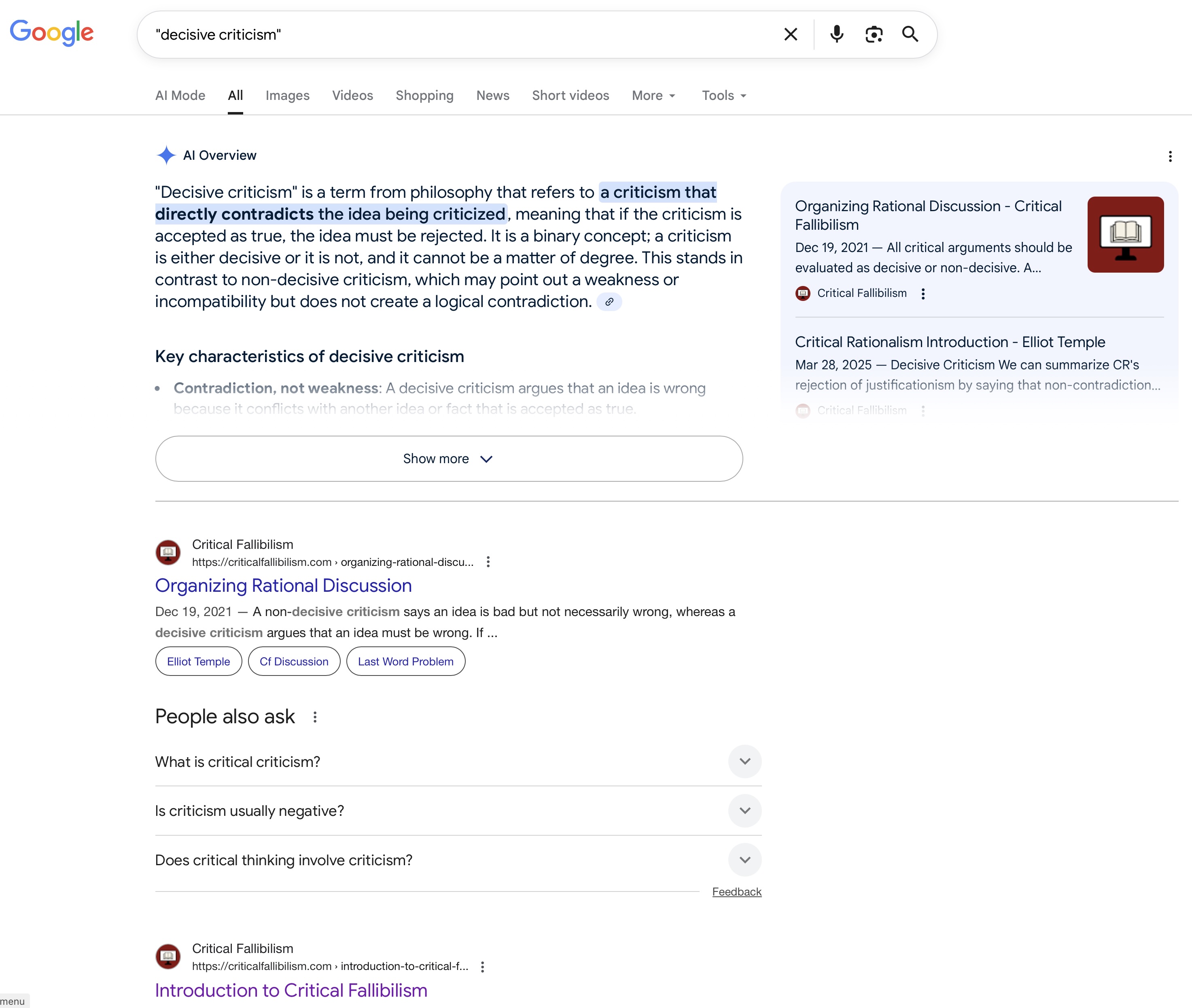
Hackethal also used CF's exact term "decisive criticism". He may be so immersed in studying CF that he doesn't realize how unique this term is to CF. Google searching "decisive criticism", the top two results, AI summary and sidebar (AI sources) are all CF material:

Decisive criticism Google search

Would I give each idea a slider where people can say how ‘good’ the idea is? What values would I give the slider? Would the worst value be -1,000 and the best +1,000? How would users know to assign 500 vs 550? Would a ‘weak’ criticism get a score of 500 and a ‘strong’ one 1,000? What if tomorrow somebody finds an even ‘stronger’ one, does that mean I’d need to extend the slider beyond 1,000? Do I include arbitrary decimal/real numbers? Is an idea’s score reduced by the sum of its criticisms’ scores? If an idea has score 0, what does that mean – undecided? If it has -500, does that mean I should reject it ‘more strongly’ than if it had only -100? And so on.

Criticizing score systems is a main point of CF. It's found in my Introduction to Critical Fallibilism, Yes or No Philosophy and Score Systems, Yes or No Philosophy (paid educational product), Yes or No Philosophy Summary (which has links to many other relevant essays), and Multi-Factor Decision Making Math.

In my understanding, Popper’s epistemology [...] does not assign strengths or weaknesses.

It's a core CF idea, repeated in many essays, to not evaluate how strong or weak ideas are. E.g. Introduction to Critical Fallibilism: "CF’s most important original idea is the rejection of strong and weak arguments." This is what my Yes or No Philosophy material is about.

It's [false that Popper avoided strength and weakness](#) like CF does.

If [the proponent of an idea] fails to address even a single criticism, the idea remains problematic and should be rejected.

If you can think of neither a revision of [an idea] nor counter-criticism to [a criticism of that idea], your only option is to accept that [that idea] has been (tentatively) defeated. You should therefore abandon it, which means: stop acting in accordance with it, considering it to be unproblematic, etc.

And (from Hackethal's Twitter):

4. Re decisiveness of criticism [bold in original]

[...] any criticism, no matter how small, is decisive if left unaddressed.

I've covered the issue of not discounting "small" criticism repeatedly, e.g. in Ignoring “Small” Errors and “Small” Errors, Frauds and Violences.

The main idea in these quotes is that criticism is decisive: it only takes one (non-refuted) criticism to refute an idea so that we should reject it. This is a core CF idea repeated in many essays, e.g. Introduction to Critical Fallibilism: "Criticisms should be decisive, rather than merely saying an idea isn't great. That means you don't accept both the criticism and its target because they’re incompatible".

I also discussed this with Hackethal on a call. And there was also a section titled "All Criticisms Are Decisive" in a confidential CF document I sent Hackethal in 2019. I'll provide details in the "Teaching Calls" and " Confidential Documents" sections below.

Any criticism no matter how small destroys its target decisively if unaddressed. Whether or not its decisive is determined by whether or not there are any counter-criticisms, not by assigning some strength score (a remnant of justificationism). A criticism is decisive as long as there are no counter-criticisms. In the absence of counter-criticisms, how could it not be decisive? [source, mirror]

This uses my decisive criticism idea again and my point about "small" criticism. It also refers to the "target" of a criticism. I used that "target" language in Introduction to Critical Fallibilism.

I said that scores are a form of justificationism in Kialo and Indecisive Arguments and other essays.

Also, decisiveness and refutation status are different things. A criticism is decisive if it contradicts its target so they can't both be correct. A criticism refutes a target if it's both decisive and non-refuted. A successful counter-criticism makes a criticism refuted, not indecisive. While Hackethal is recognizably copying CF, he's also introducing some errors.

That’s a fair concern if you’re talking about duplicate criticisms, which public intellectuals do field. The solution here is to publicly write a counter-criticism once and then refer to it again later.

I called this a "library of criticism" in Yes or No Philosophy. Hackethal calls Veritula a "dictionary for ideas". The "dictionary" keeps track of ideas and lets people refer to them again later so that they don't "have same [sic] discussions over and over again". My "library of criticism" also let people "refer" to "counter-criticisms [and regular criticisms] ... again later".

I've also talked about this repeatedly in my many essays ("Thinkers should write reusable answers to arguments") on Paths Forward ("You can reuse answers that were already written down in the past, by you or others." and "Most bad ideas get pretty repetitive. People will keep bringing up the same points over and over. That’s fine. They don’t know better. You can deal with it by answering the issue once, then after that refer people to your existing answer.").

If you’re talking about new criticisms, however, I think you should address and not dismiss them.

This is also in my original Paths Forward essay: "If there are good ideas already written down (or in any format which allows reuse), then you can save lots of time. If there aren’t (reusable) answers yet, then the issues people are raising are worth taking some time to answer properly."

My Paths Forward Summary makes this point too: "In general, either an issue has been answered before or else it’s worth the time for someone to answer it."

Discussion trees

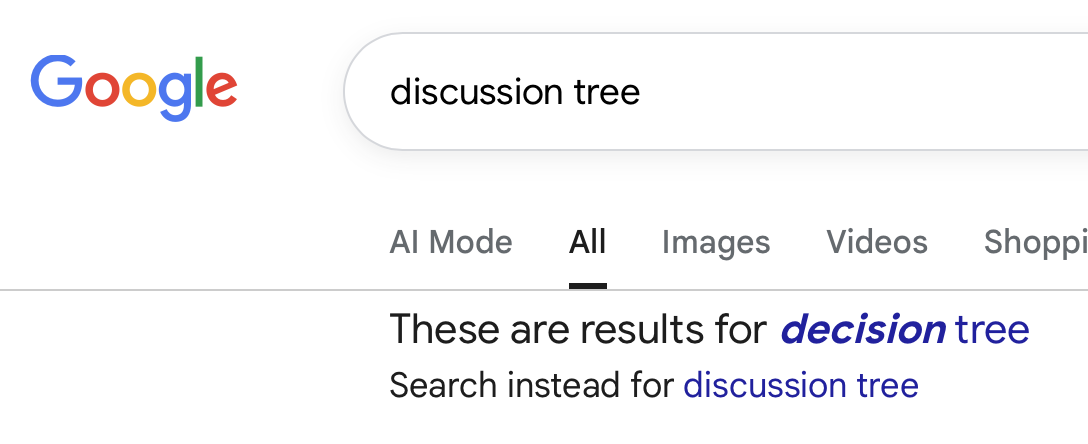
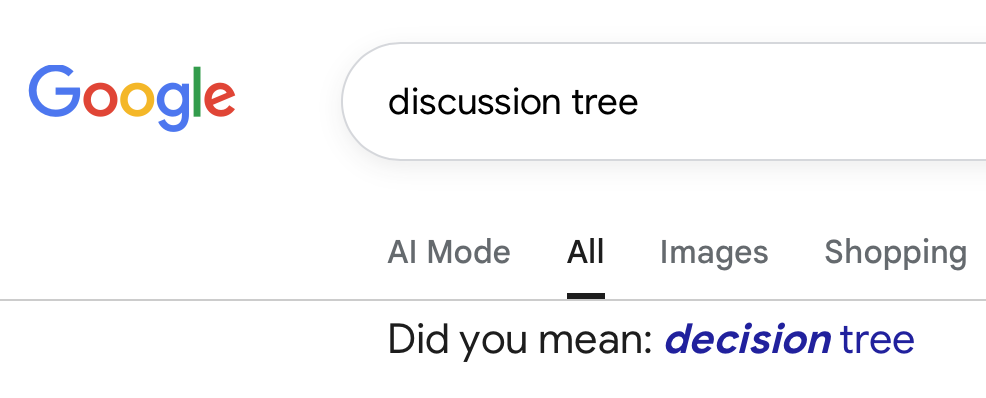
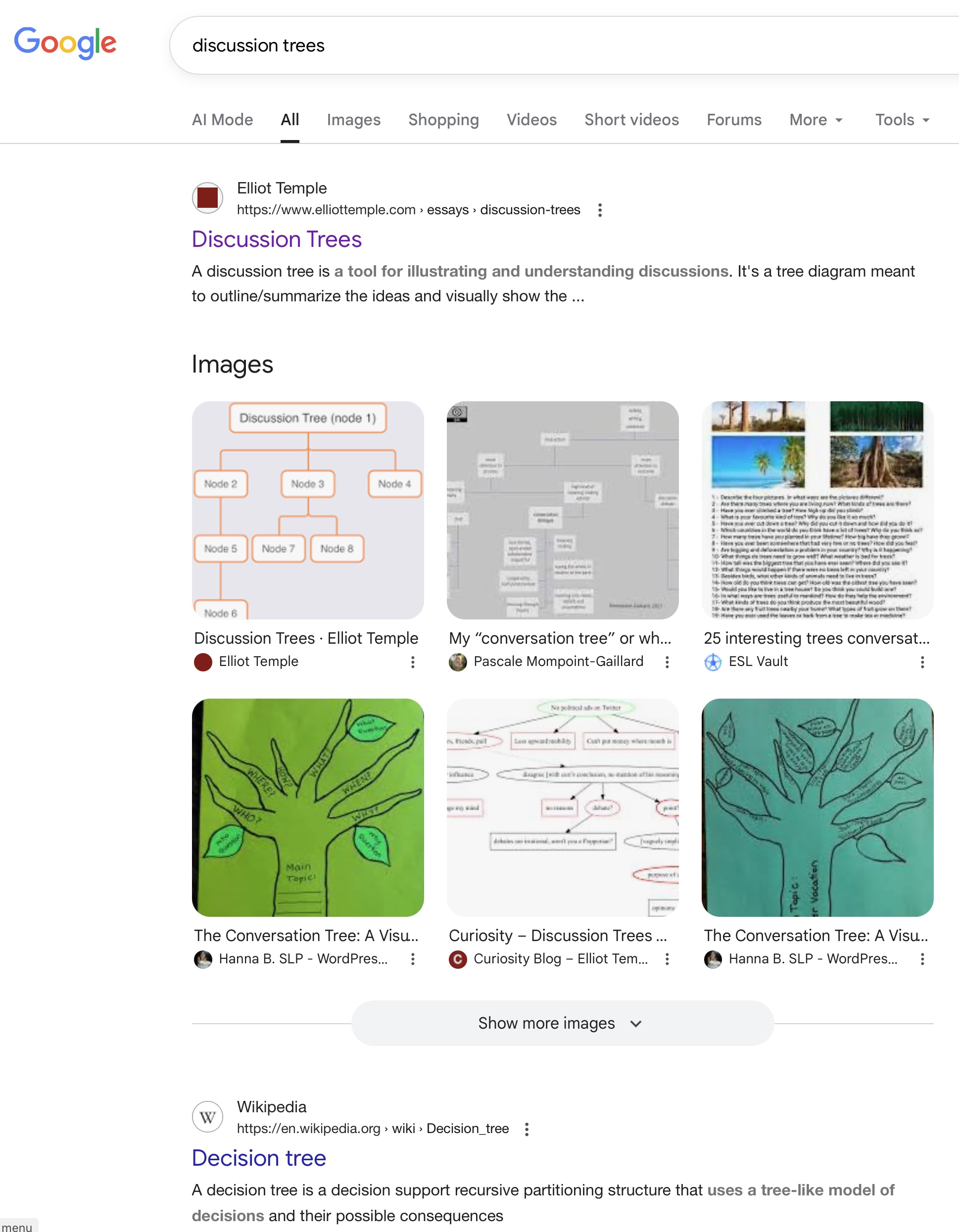
This is a distinctive CF term. Maybe Hackethal has studied CF so much that it seems like a normal term to him, not a recognizable part of CF. On Google, searching for discussion trees, the only relevant result is my essay Discussion Trees; the rest of the results are for decision trees. And searching discussion tree, Google automatically gives results for decision tree.

Discussion tree search

Discussion tree search 2

Discussion trees search

Since there can be many criticisms (which are also just ideas) and deeply nested counter-criticisms, the result is a tree structure. For example, as a discussion progresses, one of its trees might look like this:

Comments that aren’t criticisms – eg follow-up questions or otherwise neutral comments – are considered ancillary ideas. Unlike criticisms, ancillary ideas do not invert their respective parents’ statuses. They are neutral.

The idea of comment or question nodes is in my Discussion Trees essay: "A node can be e.g. a statement, claim, argument, explanation, question or comment."

The idea that the comments are neutral, rather than refuting their parent, is also in my essay: "Positive arguments, inconclusive negative arguments and explanatory comments are never decisive arguments." and "Decisive arguments shouldn’t be ignored. They’re mandatory to address. Other nodes don’t necessarily have to be dealt with."

The idea that criticisms refute their parent node is also in my essay: "Decisive (also called conclusive or essential) arguments argue that the parent is incorrect." and "If a decisive argument node or group is resolved as correct, then its parent must be resolved as incorrect."

My essay emphasizes distinguishing between neutral and non-neutral nodes: "Figuring out which arguments are decisive or not, and focusing on making and resolving decisive arguments, is the most effective way to reach a conclusion." I emphasize this distinction so much that I suggest deleting all indecisive nodes as an option: "You can convert a discussion tree to a strict debate tree by deleting all indecisive parts. More informally, you can include indecisive arguments and commentary in a debate tree as long as the decisive and indecisive parts are clearly labelled".

Again, criticisms are also just ideas, so the same is true for criticisms.

This is in my essay Artificial General Intelligence Speculations. I also told it to Hackethal on a call. I'll provide a quote from the call in the "Teaching Calls" section below.

Veritula implements a recursive epistemology. For a criticism to be pending, it can’t have any pending criticisms itself, and so on, in a deeply nested fashion.

That's how CF says criticism works. I described that system in my Discussion Trees essay. I've also talked about recursion in epistemology repeatedly, e.g. in Resolving Conflicting Ideas. I also talked with Hackethal about recursion on a call when he paid me to teach him about philosophy.

[Veritula] does not tell you what to think – it teaches you how to think.

Introduction to Critical Fallibilism: "Overall, CF helps explain how reasoning works. It provides tools and methods you can use to think better. It’s more about how to think than what to think. It enables you to think better rather than telling you what beliefs to have." While this isn't an original idea, it adds to the pattern where Hackethal keeps saying the same things as me.

Visions of Grandeur

Tom Nassis, who presumably didn't know Veritula misattributes CF's ideas to Popper, said: "Veritula deserves to scale to the size of Wikipedia." Hackethal replied (mirror):

I agree that Veritula deserves to scale to something huge.

Hackethal believes the CF ideas he's using, without crediting me, are extremely good, important and valuable. He's a fan of CF who has been trying to persuade people that CF is right while David Deutsch and Popper are wrong. But he calls it Popper being right and Deutsch wrong, and he pretends that CF doesn't exist. Actually, Popper's ideas were different than CF.

Quoting Benjamin Davies, Hackethal wrote (mirror):

I would also consider financially supporting someone who gave me good reason to think they had the vision, the motivation, and the technical skill to create it.

I’m interested. Let’s continue this discussion privately for now. Email me:

Hackethal is using my ideas to pretend to have a vision. He's trying to secure financial support for himself using my vision and my ability to develop good new philosophical ideas.

On his blog, Hackethal wrote:

somebody [in person at a Popperian event] suggested I start a movement called ‘Hackethalism’. I rather like that name

Some people apparently now believe he has great, original philosophical ideas. Which ideas are "Hackethalism"? If they're my ideas, we have a problem. If they're other ideas, which ones and where are they published? I've never seen Hackethal write significant, original ideas.

I fear that he wants to get rich and famous by taking my ideas and naming them after himself. It's flattering if he likes my ideas so much that he wants to put his name on them, but that's not OK. Renaming Critical Fallibilism to "Hackethalism" would go beyond normal plagiarism.

Naming it "Hackethalism" also contradicts his other strategy of attributing the ideas to Popper (which I refuted). Logically, CF's ideas can't, at the same time, be Popper's ideas that he wrote decades ago and also be new ideas called "Hackethalism".

Other Copying

Hackethal made an anti-misquotes website. Opposing misquotes was an ongoing campaign of mine for many years before Hackethal started writing similarly about it. When participating in my community, Hackethal was exposed to my ideas about quotations in multiple emails and chats before he started studying my work from a distance. On 2019-02-11, as a forum moderator, I brought up an issue with Hackethal's quoting to him because, like most newer members, he violated the group policies.

Hackethal also copies me in small ways, e.g. coloring italics red. For many years I've changed the color of italics in my articles so they visually stand out more. This can't be plagiarism since Hackethal doesn't claim credit for inventing the idea. I don't think colored italics are my original idea, but I think Hackethal probably copied the idea from me.

Hackethal probably also copied the way I write a lot in my own blog comments section following up on my own posts. It's an unusual thing to do. Copying it isn't plagiarism since Hackethal doesn't take credit for the idea. And I'm not claiming it's my original idea. But I do think he got it from me. It adds to the pattern of him studying and copying me.

Hackethal wrote on Veritula, "We can criticize theories for being arbitrary (which is another word for ‘easy to vary’)." Before The Beginning of Infinity was published, I argued to David Deutsch that "easy to vary" was the same issue as being arbitrary. I've made this point publicly too.

In Hackethal's Where's David Deutsch's Accountability? (mirror), we find more evidence that he's studied my writing. It seems inspired by me. It uses a lot of my approach to criticism and my style. It's his best post that I've seen. It has some good criticism of Deutsch. It isn't plagiarism and giving credit for general inspiration isn't mandatory (though it's often good, to and people often do it). While the post uses some of my methods, it doesn't explain those methods or otherwise try to take credit for inventing them. The substantive points critiquing Deutsch are adequately original to avoid plagiarism even though they're similar to points I've made. The use of Atlas Shrugged quotes is similar to my writing – I've used similar quotes from the same book for similar purposes before – but it doesn't cross a line by itself. It adds to the overall pattern and helps show how much Hackethal has learned from me. I've had multiple people comment about how some of his writing sounds extremely similar to mine (for both style and content).

I also have two examples from the comment section on that post, both written by Hackethal:

why hasn’t he [Deutsch] made any meaningful progress in the past ~15 years, possibly 25?

The 15 year end of the range comes from a simple analysis: Deutsch's book The Beginning of Infinity (BoI) involved progress but he hasn't done anything major since then. While I've said this, someone else could realistically come up with the same idea themselves.

But what's going on with the 25 year end of the range? That's saying Deutsch stopped making progress long before publishing BoI. How would Hackethal know that? It's an unusual thing to claim without insider knowledge. I knew Deutsch personally during that time period and helped with BoI (Hackethal did not). I've publicly commented about Deutsch knowing most of the ideas in BoI long before publication and not being very productive in the decade before publication. Am I Hackethal's source for this? I don't know of another public source for this claim besides me.

And think of how much more progress Deutsch could make if he was more methodical and did fewer, easier things!

This isn't plagiarism. It doesn't take credit for my ideas. It doesn't even explain the idea it's talking about. Someone else saying it might mean something different. But I interpret it as Hackethal talking about one of my ideas that I've discussed many times, but without citing me. I think it shows how immersed in my work he is that he writes short, vague references to my ideas, without giving links, and he seems to expect people to understand what he's saying.

Hackethal spent months in my community, hired me to teach him, and wrote around 50,000 words about me (including many quotes of obscure stuff I said, not just in essays but even in old chatroom archives). He's known about my work for seven years and seems to have studied it extensively. I don't think him writing about the same ideas as me, including my original ideas, is a coincidence.

Teaching Calls

In 2018 and 2019, Hackethal hired me to help him learn philosophy. He did not hire me to ghost write for him. I've never sold ghost writing services. He didn't ask for, nor receive, permission to use any of my ideas without crediting me.

During our 2019-01-27 call, we discussed Critical Fallibilism (specifically some of the core ideas that I also call "Yes or No Philosophy"). "David" refers to David Deutsch. This is edited slightly to delete some "umm", "like", ungrammatical repetition, and minor interjections like "yeah". Quotes:

Temple: I think that Popper and David's versions have flaws, and definitely incompletenesses, and that I've discovered a few of them. And I think there's more out there, besides what I've discovered, that still needs fixing or clarifying or something. The biggest one is the Yes or No Philosophy stuff, that ideas should be evaluated in a boolean way, a binary way, rather than with a real number score. So I divide ideas into refuted and non-refuted. And Popper and David are both somewhat ambiguous on this and don't look at it in that way. And that leads to problems. In the Yes or No Philosophy material, I have like a dozen quotes from each of them, from their books, where I point out parts that I disagree with or find ambiguous

Hackethal: I was gonna ask you, okay, so evaluating ideas in a binary way, that's your solution to the problem of evaluating them in a real number system?

Hackethal knows, and said on a call with me, that evaluating ideas in a binary way is my solution.

Temple: You would actually get a much better value buying [my Yes or No Philosophy educational product than paying for calls] because I spent a month making videos and essays so that I would have reusable material that lots of people could learn from.

Hackethal: Okay. So Yes or No Philosophy is your philosophy that addresses shortcomings in both Popper's and Deutsch's philosophies?

Hackethal knows that I developed new ideas like Yes or No Philosophy to address shortcomings in Popper's and Deutsch's philosophies.

During our 2018-12-24 call, I told Hackethal that criticisms are just ideas:

[Elliot Temple:] One of my ideas about where to start [on artificial general intelligence] is with a data structure for ideas. Because I think it should have certain properties that are hard. And I'm not aware of any progress on this, but I think it's important to have some sort of data structure that is for ideas universally. Like not having different data structures for different types of ideas, but having one generic one, so that all ideas are treated the same. And the things that it needs to be able to do include criticisms. So, like, I don't think there should be a separate data structure for like claims about the world and for criticisms. I think it'd be one generic data structure. Okay, and then you have to have some way of figuring out like, which ideas are criticisms of which other ideas, like which ones are in some way pointing out an error and another idea.

Confidential Documents

As part of the paid teaching, I sent Hackethal a 59 page CONFIDENTIAL DRAFT Critical Fallibilism Website.pdf. Perhaps I was too naive and trusting, although I already had already published other writing about most of the ideas in the document. I challenged critical preferences in 2010, then wrote other essays, then released my Yes or No Philosophy product in 2017. I taught my Critical Fallibilism course in 2020 and launched the Critical Fallibilism website in 2021. Hackethal launched Veritula in 2024.

Here are quotes from CONFIDENTIAL DRAFT Critical Fallibilism Website.pdf (I fixed the link because the website moved):

Elliot Temple’s improvements [to Karl Popper's Critical Rationalism] include:

  • Yes or No Philosophy explains that ideas should be judged in a binary way: non-refuted or refuted. We can always act on non-refuted ideas, despite having limited resources such as limited time.

Yes or No Philosophy

A “binary” issue is one with only two answers, e.g. yes or no. Epistemology is fundamentally binary. E.g. you can accept an idea, or not. You can reject an idea, or not. You can decide a criticism refutes an idea, or not. You can decide an idea solves a problem, or not.

The idea of supporting arguments is a mistake. The idea of strong or weak arguments is a mistake.

People commonly find binary judgements difficult or scary. They want to hedge or equivocate. That only makes things worse. Either you accept and act on an idea, or you don’t, and there’s no point in being vague about which one you’re choosing and why. (If you accept and act on a compromise idea, you have accepted and acted on a different idea.)

Non-Refuted

We should accept and act on non-refuted ideas. There’s no higher or better status an idea can have, no positive justification.

Why should we choose non-refuted ideas? Because they have no known errors and the only alternatives are refuted ideas: ideas that do have known errors. An idea that we don’t see anything wrong with is preferable to one that we do see something wrong with. What if we have multiple, competing, non-refuted ideas to solve a problem? Then it doesn’t matter which you use; they’re all fine. You may change problems to a more ambitious one if you like (by adding extra requirements to your goal, you can rule out some solutions and then act on one that gives you something extra), but you can also just proceed with any solution and move on to thinking about something else.

What if you have two non-refuted ideas that contradict each other, and each claims the other won’t work? Then since neither can address the matter satisfactorily (and thus guide you about what to do), they are both refuted. Both are inadequate to guide you in how to address this problem. Then your options are to solve a less ambitious problem (e.g. given you don’t know how to resolve the conflict between those two ideas, what should you do?) or to brainstorm new solutions to this problem (e.g. try to come up with improved, variant ideas).

All Criticisms Are Decisive

Either an idea does or doesn’t solve a problem (equivalently: accomplish its purpose). People don’t understand this due to stating problems vaguely without clear criteria for what is and isn’t a solution. Fix your problems and you’ll find that all criticisms are decisive or do nothing (there’s no in between). A criticism either explains why an idea won’t achieve the success criteria its supposed to (so don’t use it), or the criticism doesn’t explain that.

When you act, you pick an idea to accept and you reject the alternatives. Life involves binary choice. Your thinking should mirror this. Hedging won’t get you anywhere because you still have to act on some ideas and not others. When you act, you have some kind of plan, strategy or idea behind the action. If you have multiple ideas, then either they fit together as one big idea, one overall plan, or else you’re trying to act on contradictory ideas at the same time and will fail.

Confusion about this is common because of compromise ideas. What if there are two extreme ideas and you find a middle ground? Then you rejected both extreme ideas and accepted a third idea, which is a new and different idea (even though it shares some pieces with the rejected ideas). So, as always, when you act you accept some idea about how to act and reject all the others. If the accepted idea is a complex, multi-part idea which contains some good aspects of rejected ideas, that doesn’t prevent it from being a single idea in its own right that you’re accepting and acting on, while the other versions of it and rivals are all rejected. For a given issue, you always have to pick something you accept and reject everything else.

I also sent Hackethal Call 2 Notes.pdf (6 pages) which included this (I fixed the link):

Yes or No Philosophy

Popper talked about critical preferences where, in light of the criticism, we prefer some ideas to others (as a matter of degree). He also talked sometimes about strong and weak arguments (as a matter of degree). I criticize that and propose a binary approach. I still view this as building on Popperian philosophy, but it’s more of a criticism than the other material that adds extra stuff. I think this approach makes epistemology more elegant and cleans up lots of small issues in addition to the major corrections. I argue that all ideas should be categorized as (tentatively, fallibly) non-refuted or refuted, and provide methods for dealing with the situation of having rival non-refuted ideas. Similarly I claim all criticisms are either decisive or false (no partial criticism or partial refutation). A criticism either refutes an idea or has no negative effect at all.

It’s a big change from the mainstream epistemology that tries to evaluate how good ideas are as a way of choosing between them (they will use criticism some, but then they will have multiple ideas they regard as not being decisively refuted, and they use how good to choose between those). But it’s about equally different from what many Popperians might try using instead: judging how bad ideas are as a way of choosing between them. One can replace supporting arguments with critical arguments while still keeping the same approach of essentially giving ideas scores/points, which I think is wrong.

Understanding this will give you a different perspective on fitness functions.

https://yesornophilosophy.elliottemple.com

Resources

Read and watch these to learn more about plagiarism:

Articles:

Videos:

Conclusion

Hackethal uses Critical Fallibilism ideas extensively without crediting me, particularly for Veritula. This is similar to how I previously accused his book of plagiarizing me.

Falsely saying CF ideas come from Popper (with no evidence, quotes or citations) does harm. Like plagiarism, it uses my ideas without crediting me. It also implies I plagiarized Popper. It confuses people about what Popper's views were and attributes unpopular ideas to him. It implies that Popper experts like David Deutsch and David Miller misunderstood Popper (Hackethal is implying that their books are bad.) It's worse than plagiarism.

If Hackethal changed his mind about what he said during our call ("so evaluating ideas in a binary way, that's your solution", "So Yes or No Philosophy is your philosophy that addresses shortcomings in both Popper's and Deutsch's philosophies?"), he should have explained that and argued his case using Popper citations. Attributing those ideas to Popper without evidence is unfair to me, Popper, and other Popperians.

It took me over twenty years to develop CF to what it is today. Hackethal is misappropriating my life's work as a shortcut. Instead of developing original ideas, which is hard, he found someone who isn't famous (me) and is using their ideas without crediting them.


Elliot Temple | Permalink | Messages (0)

Dennis Hackethal Is a Bully

After threatening to sue me and writing five blog posts about me, Dennis Hackethal published another blog post, some long blog comments (some could be posts but he put them in the comment section) and multiple videos attacking me. It's over 10,000 more words and 1.5 hours of video. He also sent me eight rude tweets in a row even though I'm blocking him on Twitter (he used a second account to get around the block). The tweets taunted me and said "I plan to make many more videos about you". He won't leave me alone, won't discuss our conflict, and isn't interested in deescalation. He also doxed me. He's trying to bully me into removing everything I ever said about him from the internet, which is one of his twenty non-negotiable demands.

Despite this, I tried ignoring him again. After his lawsuit threat, I ignored him for eight months and refrained from blogging about it. After his blog posts about me, I responded minimally, then ignored him for six months despite his many followup attacks. Then, in addition to continuing to attack me and recently hassling my fan when he tried to discuss my philosophy ideas online (unrelated to Hackethal), Hackethal made a website, Veritula, which uses Critical Fallibilism ideas without crediting me. Unfortunately, I don't think ignoring Hackethal is a viable option. He won't leave me alone.

For context, please note that he asked me not to respond to his posts. He said he wouldn't discuss and that he would consider it mistreatment of him if I or any of my associates wrote responses to his accusations on our own websites. My silence was not in response to him wanting to discuss the conflict, which he said he wouldn't do. Silence is what he asked for (but has no right to).

This post will respond to multiple issues in a series of fairly independent sections. One of my main themes is that Hackethal's factual claims are often false and often contradict his own sources, so don't believe his statements without analyzing the evidence yourself, even if they appear well-sourced.

These are mostly points I could have made six months ago, but I tried to deescalate instead, which didn't work.

False Claims

There's a pattern where Hackethal's statements about me and what happened are misleading, factually false, or involve logical errors. Here's a representative example.

In my 2024-05-28 letter to Hackethal's lawyers, which I didn't get a reply to, I wrote:

I find it implausible that Hackethal is genuinely concerned about potential harm to his reputation from my posts given what he's been posting online under his real name. For example, after sending the cease and desist letter, he blogged:

"Men should check a woman’s average weight for the past five years (eg social-media pics)."

"Husband and wife are not ‘partners’. The wife is the husband’s support system. He leads, she follows."

"From a man’s perspective, a girl with piercings and tattoos doesn’t look like a wife or mother; she looks like a girl you have sex with and then get rid of."

"When a woman asks you what you do for a living, she wants to gauge how much money you make. You should be able to counter the question with: how much do you charge for submission?"

"It’s not fair for a severely overweight woman to expect her man to be loyal."

These quotes are from May 21, 2024 on Hackethal's blog at [redacted]. They show that he's not making a serious attempt to build a positive reputation as an innovative philosopher.

Eight months later, Hackethal blogged a response (link omitted, and I didn't use the word "proof" so those must be scare quotes):

In his correspondence with my lawyers, Temple said he found it implausible that I was concerned with my reputation. As ‘proof’, he gave out-of-context quotes from an article where I paraphrase controversial things someone else has said. I even give an explicit disclaimer at the top of the article saying “I don’t agree with everything [that person] says […]” (emphasis in the original!). Temple conveniently didn’t mention either of these facts and presented quotes as if they were my views. That’s lazy and dishonest.

Here's the disclaimer (bold added):

Kevin Samuels was an image consultant with a successful YouTube channel about dating and relationships. I don’t agree with everything he says, particularly his advocacy for the corporal punishment of children, but he has provided valuable advice about relationships to men and women alike. I’ve listened to and analyzed several dozens of his episodes, and discussed many as well. Here are my key takeaways from his show.

I thought Hackethal disagreed with Samuels about corporal punishment and some other topics, but agreed with a lot of Samuels' views on women and relationships. In particular, I thought that Hackethal agreed with his own "key takeaways" from Samuel's "valuable advice". He also called them "Key Insights" in his post title. And he's posted similar opinions on Reddit. So who is being misleading or "dishonest"?

Factual Errors

Here's another illustration of how (un)trustworthy Hackethal is. He wrote (bold added, link to his Quote Checker website removed):

[Elliot] claims I reached out to him in bad faith last year because I “was already researching lawsuits a month before that conversation […]”. I wanted to find lawsuits stemming from misquotes so that I could market my tool Quote Checker as helping people avoid such lawsuits because Quote Checker helps them quote properly. My legal complaints against Elliot have to do with defamation, not misquotes, and the link he gives is clearly about misquotes, not defamation, so there’s no reason for him to draw this false connection.

The Law Stack Exchange page in question isn't just about misquotes. The word "defamation" is on the page 18 times.

Please don't believe things just because he states them as facts and provides source links. His claims often contradict his sources.

Hackethal Hassled Justin Mallone

I'm not Hackethal's only target. He's attempted to bully Justin Mallone on Twitter and YouTube. Here's Mallone's final comment (with reformatting):

I initially was honestly annoyed at YouTube's moderation and wanted to give you [Dennis Hackethal] an opportunity to post your thoughts and have tried to engage with you a bit. Based on your replies here, I now think that was a mistake. You seem to be engaging in bad faith. I do not believe you are represented [by a lawyer]. I think you are bluffing. I do not think any person operating with legal advice would conduct themselves in the manner you are conducting yourself. I also do not think any reputable law firm would have any association with you. You also appear to be trying to weaponize "no contact requests" (which you appear not to understand) to let you post things without having to deal with replies. I will be deleting your YouTube comment and blocking you. Please do not contact me personally again. If you do indeed have lawyers, you can have them communicate for you.

Also, I think you are being abusive and unfair towards Elliot and should frankly get over criticism you didn't like that happened half a decade ago and move on with your life. The fact that you're stalking my forum visits is creepy as hell, btw.

People curious about this dispute should try reading Elliot's perspective instead of taking Dennis' vitriol on faith.

Plagiarism

Hackethal wrote:

I don’t believe Elliot mentions in his new articles that I have long addressed his complaint about ‘plagiarism’. (Five years ago!) By not mentioning that, he misleads his readers yet again.

I don't know what he's referring to. In the context of refusing to have back-and-forth communication where I can ask questions, it's unreasonable for Hackethal to say things like this without providing details or evidence.

I'm not trying to be difficult. I've tried to think of what he could mean and I've asked others if they know. Because the plagiarism topic is particularly important, I'll respond to my best guess about what he means. Note that he said he addressed it five years ago, so he can't be referring to anything in his recent blog posts.

My guess is that Hackethal means he addressed my plagiarism complaint by creating a second edition of his book, A Window on Intelligence.

Hackethal's position is, in the words of his lawyers: "Mr. Hackethal has never plagiarized anyone." The second edition of his book is irrelevant to this (unless it contains plagiarism). If the first edition contained plagiarism, then Hackethal did ever plagiarize someone.

My blog post was about the first edition. No changes in the second edition could make my statements about the first edition false.

Hackethal hasn't updated his book's website to say there is a second edition. As far as I know, he hasn't announced it or tried to notify the public about it. He hasn't said what changes it contains or why he made it. He hasn't apologized for the first edition or retracted anything.

I bought the book on Kindle but my ebook wasn't updated to the second edition when that came out in 2020. I couldn't even buy the book again to get the update because I already owned it. When I received a cease and desist letter in 2024, I still didn't have access to the second edition. After Hackethal started blogging about me in 2025, I checked again and he'd finally sent the update to Kindle customers like me, four or five years late.

Quoting Defamation

Suppose I'm a journalist or blogger. An anonymous source sends me a tip: a celebrity is a chainsaw murderer. I publish an article accusing him of chainsaw murder. It turns out he's not a murderer. He sues me for defamation. Who will win? He will.

Now suppose I get the same tip but I'm a little more careful. I publish an article quoting an anonymous email accusing the celebrity of chainsaw murder. I don't make any accusations myself; I just truthfully, accurately share quotations. The celebrity sues me for defamation. Who will win? He will.

In the scenario, I did no fact checking or due diligence. I recklessly and/or negligently published a damaging, false claim. Quotation marks don't automatically make me innocent when I introduce the claim to the public or repeat it.

Hackethal published quotes attacking me, which he calls testimonials, mostly from anonymous sources. Some of the information is factually false. Hackethal's justification is:

But just so my readers know that these are real quotes from real people, let me state that I could easily produce the original texts in court one day, if ordered to.

Even if the quotes are accurate (someone else really said those things to Hackethal), it's still defamation. Before publishing those claims, Hackethal should have fact-checked them. He published them on his website so he's responsible for their correctness.

A common journalistic practice is to get two independent sources before publishing a claim. Hackethal didn't make reasonable efforts to ensure that the highly damaging statements he published were actually true. He's also refusing to communicate, so he won't retract them now or listen to corrections. His behavior is careless (or worse) and violates civil law.

Hackethal also published a wild email he (claims to have) received from an anonymous person. The email insults me and confesses to harassing me for years, which would be a crime if they weren't lying (they appear to be at least partially lying). Hackethal presented it as a quotation, but that doesn't mean he didn't do anything wrong by publishing it. He doesn't appear to have done fact checking before publishing. The confession basically says they did all the harassment, therefore everyone else is innocent. It provides no evidence and ignores the times people harassed me using their real names.

I reiterate my request that Hackethal retract defamatory materials about me, including quotations. I'd be willing to provide additional details and report more factual errors if Hackethal were willing to receive information and do removals or corrections.

No Contact

Hackethal wrote in a blog comment:

In addition to posting new defamatory articles about me, he [Temple] has also broken my no-contact request. As a result, I now consider his no-contact request null and void.

I don't know what he's referring to. I didn't contact him before he posted that. (I did later CC him on an email to his lawyers, who still have said nothing to me for over a year.) My best guess is he's referring to me writing blog posts responding to his posts about me. I don't think demanding people stop defending themselves on their own blogs is how no contact requests work, but that is what his request's wording appears to say.

Note: Hackethal was welcome to send me emails related to our dispute. He wasn't welcome to contact me in other ways, such as off-topic emails or switching Twitter accounts to send me more rude tweets. As far as my no contact request is concerned, of course he's allowed to blog about me because that isn't contact; the problem with his blog posts is that they're defamatory cyber bullying and contain factual falsehoods. However, after escalations like doxing, I have a new policy for Hackethal: he's no longer welcome to contact me at all. His lawyers can contact me if necessary. I'm also willing to communicate with other people, besides Hackethal, to attempt conflict resolution.

Hackethal also commented:

Elliot has yet to respond to [multiple things Hackethal wrote] (all of which he’s hiding by not linking to my exposé). (Wait for him to twist the part “has yet to respond” into me requesting more defamatory blog posts about me.)

and

[Elliot's] been evading several issues such as plagiarism, disregard for copyright, invasion of privacy, etc. Like, he hasn’t commented on them at all.

I find his complaint about me not responding enough to him bizarre given that:

  1. He's openly, explicitly refusing to discuss our conflict with me.
  2. He issued a no contact request to me.
  3. I already wrote a response letter over a year ago and I'm still waiting for a reply.
  4. He doesn't like any of my responses.
  5. When I do respond, he claims it's illegal defamation without giving useful specifics. That discourages responding, especially considering that he's threatened to sue me.

He also complained about me not providing links to his exposé. I generally try not to link to rights-violating content. Also, as I read it, his no contact request said not to link to him, so he seems to be contradicting himself by wanting a link. And it's not difficult to find his posts.

Breaking People

Hackethal says I've bragged about being able to "break" people (meaning writing enough criticism that people don't want to talk anymore). That's false: I didn't brag about that; I lamented it. That's a bad outcome that I try to avoid. People sometimes ask me to share all the criticism that I can, with no limits, and I sometimes respond by warning them against that and refusing to do it. I used to be more trusting of people who said they liked and wanted criticism, but I've become more skeptical.

For example, Hackethal wrote (mirror):

Elliot Temple is a bad, dangerous person who repeatedly verbally abused Deutsch, delights in ‘breaking’ people (his words, not mine), invades their privacy, lies to ruin their reputation, and more.

I never said that I delight in breaking people. It would be bad enough to accuse me of that, but falsely saying that I admitted it, and that it's my words, is really nasty. This is another example of how you shouldn't trust what Hackethal says.

Doxing

Dennis Hackethal doxed me. I don't share my photo online. He published photos of me.

Quotes and Sources

Hackethal frequently uses source links to make his claims look true. The source links often go to very long posts, not to anything specific. If you make a non-specific claim like "John is toxic", then a non-specific link to a long post on the general theme of John's toxicity is appropriate. In that case, the linked post has multiple relevant parts and the majority of it is relevant. If you make a specific claim, like that John said X or did Y, then a specific source is needed, not a link to an entire long post that may or may not contain a small, relevant section somewhere in the long post.

When Hackethal gives a quotation, it may be accurate but then he may make incorrect statements about what the quote said or uses flawed logic to draw incorrect conclusions from the quote. If you do a close reading to compare the quotes to the commentary on the quotes you can find major discrepancies. Similarly, when he paraphrases a quote he just gave, or paraphrases a source link, the paraphrase is often inaccurate.

The errors are frequent enough that many people would see it as unreasonable and be caught off guard because they don't expect a writer to be that unreasonable, especially when the general format (quotations and frequent source links) looks good and the author writes in a reasonably formal, educated style. I've given several examples of errors in this post but they're just a few representative examples and I wanted to warn people that there are many more.

Testimonials

Hackethal posted anonymous testimonials attacking me. He admits to editing them. He doesn't even claim to have gotten the approval of the authors for the edits (or to post the originals, for that matter). Most of the quotes appear to be people venting, not speaking for publication. He removed 5 quotes from the post without explanation. Why? Did someone complain? Does Hackethal post multiple quotes from one person but present them so readers would think they're from different people?

When a business posts testimonials, people expect that each testimonial is from a different person who isn't associated with the business (not an employee, friend, family member, etc). I find the quotes suspicious and doubt he really got that many different people, who aren't his buddies, who actually had a significant amount of experience with me, to say these things.

Also, the testimonials follow a broad pattern: Hackethal usually doesn't directly attack my actual words or actions. Instead, he focuses on people's opinions, his summaries of what he thinks happened, and other secondary issues. He says my forum community is toxic, but instead of backing that up with a bunch of quotes of me being toxic, he tries to back it up with anonymous quotes of people claiming I was toxic many years ago. The quotes don't give dates but generally seem to be referring to stuff from before the Critical Fallibilism forum existed.

Monitoring

Hackethal wrote:

Elliot vowed to monitor my success into the indefinite future to ruin my reputation by bringing up past complaints

Hackethal keeps repeating claims along these lines, so I want to make a clear statement addressing this: I did not vow to monitor Hackethal, ruin his reputation, or bring up past complaints. I have not been and am not currently monitoring his success. My goal is to protect myself, not to ruin his reputation. If he would leave me alone, then I would leave him alone.

Hackethal says he had to attack me because I would never leave him alone, so he started attacking me after I hadn't attacked him for four years. He claims to be attacking me, not because I attacked him, but because I might attack him in the future, and he has to deal with that potential threat from him misreading an old chat message. But I think this is an excuse; I don't think clarifying this point will stop Hackethal's attacks.

I blogged about him in 2020 and he escalated to lawyers in 2024 after I'd been ignoring him for 4 years. Although he was continuously selling a book that wronged me, and he refused to discuss my concerns, I tried to move on. Then when I was threatened by his lawyers, I tried to be reasonable. I offered to make some changes and to negotiate. When they wouldn't discuss the conflict, I left Hackethal alone again instead of blogging critiques of his unreasonable legal threats, but he was unwilling to leave me alone and started blogging about me in 2025.

He's done more things which I have serious complaints about (that so far I haven't blogged about) but I didn't even notice until he got my attention. I wasn't monitoring him and only reviewed his activities after the legal threats and again after the exposé. I didn't even notice the exposé about me immediately, nor the Veritula website, because I wasn't monitoring him.

Where does the monitoring claim come from? He's been reading old chat logs from my Discord server. He wasn't a member but got a copy of what was said. He's spent many hours digging through my online history to try to find dirt and stuff to be mad about (and not found much).

Regarding the old chat log, he misread, misunderstood or made logical errors regarding what was said. This fits the pattern of how he's dealt with other things.

The chat is from before my 2020 blog post accusing Hackethal of plagiarism. I'd emailed Hackethal about the issue and he hadn't responded yet. I was considering how ignoring my complaint would or wouldn't work as a strategy for him. I thought that if he ignored me, then got popular, then even if I did nothing at the time, his fans could notice or I could say something later. So I didn't see how ignoring the issue would be a good strategy for him. Having plagiarized in a book doesn't just go away and become a non-issue automatically after some years pass; just ignoring the problem doesn't solve it. There was no "vow", just a comment that I didn't think ignoring my complaint was a viable longterm strategy for Hackethal. (At the time, I thought people cared about plagiarism, but now I think I was mistaken. If people are already someone's fan and biased in their favor, they often won't care about plagiarism or many other problems. Most people don't take sides in disputes based on facts and logic.)

A few days later I blogged my complaint about the plagiarism and tried to move on with no monitoring. I didn't write a blog post about Hackethal again until 2025 after his blog posts about me.

In retrospect, I seem to have been basically correct: Hackethal tried to ignore the issue for years but he was unsatisfied with the results. But all that took was one blog post, not any additional actions or monitoring. In retrospect, he should have discussed that matter with me over email before I put up my blog post, rather than trying to ignore my complaint. What can he do now? I suggest that Hackethal stop trying to ignore the issue and instead write a response to my plagiarism accusation which refutes my accusations passage by passage. Or if he can't refute my criticism, and can't ignore it, then he should apologize, negotiate and try to fix and make up for his mistakes.

Hackethal has written over 50,000 words about me. He attacked me at length. But I don't think that's helping his reputation. And in all that text, he still didn't attempt to go through each passage I brought up and address it. Instead of defending his own actions, he focused on counter-attacking against me. Instead of using rational persuasion to show his innocence, he's trying to attack me to pressure me into silence.

Also, he says he avoided reading my blog for years to help prevent potential plagiarism of me. But then at some point he started reading my blog again. When and why? Why won't he just leave me alone and stop monitoring my philosophy work? Not reading my blog to try to avoid plagiarizing my new ideas was a good plan that he should have continued.

Recruiting

In November 2025, Hackethal wrote:

Elliot is now contacting members from my forum and trying to recruit them to his, hoping they won’t know he’s already been called out on his tactics.

This is false. I didn't do that ("trying to recruit" or "hoping"). I think this is another good example of how inaccurate many of Hackethal's claims are. To illustrate, here's a message I sent to one of my Twitter followers who has posted on Veritula (Hackethal's forum):

Hi, I thought you'd want to know that Veritula is not actually a programmatic implementation of Popper's epistemology. It uses ideas I created, so if you like them you can learn more from my essays. See: criticalfallibilism.com/dennis-hackethal-falsely-implied-that-critical-fallibilism-plagiarizes-karl-popper/

I wasn't "trying to recruit" for my forum. I didn't mention my forum. I was concerned with receiving credit for Critical Fallibilism (CF) ideas, and refuting misinformation, not with gaining a forum member.

While Hackethal presents himself as not wanting to face competition from my forum, I suspect the bigger issue is that he doesn't want people to read detailed evidence (including many quotations) that Veritula falsely attributes CF ideas to Popper.

Rather than "hoping" that people haven't seen Hackethal's attacks against me (which have little relevance to my arguments and evidence about Veritula), I have been hoping for years to discuss the conflict. I hope that people who have seen Hackethal's call outs against me will either agree with me or be willing to discuss.

It's also hypocritical for Hackethal to make this complaint after he contacted people in my audience (which he didn't disclose).

Timeline

I first talked with Hackethal in December 2018. He stopped participating at my community in April 2019. I published a blog post about harassment from Andy B in February 2020 which brought up relevant people including Hackethal (who had falsely told people that I had "insinuated violence" towards him). I published a blog post attacking Hackethal for plagiarism in April 2020 after he refused to discuss the matter by email. After that, my posts complaining about harassment focused mostly on David Deutsch, and Hackethal was barely mentioned.

There were no other major events between us until 2024 when he emailed me. That conversation wasn't productive because I didn't know why he emailed me or what he wanted. Nothing major happened in those emails. Then his lawyers contacted me and I finally found out what he wants: for me to delete everything I ever said about him and never mention him again (which would apply even if he plagiarizes me in the future). After I wrote a detailed letter to his lawyers, they stopped responding. My offers to negotiate, discuss or correct any errors in my posts were ignored or declined. They raised the concern that I had called Hackethal a criminal; I said I didn't intend to do that and I offered to remove any statements calling him a criminal if they pointed the statements out, but they ignored me. I couldn't remove the statements by myself because I didn't know of any statements that said it, and I found none after multiple rereads and searches. After his lawyers stopped responding, I didn't blog any complaints and tried to move on. But eight months later, in 2025, Hackethal started attacking me on his blog and on social media. And he has continued attacking me to this day.

See also my Timeline of Dennis Hackethal Using My Ideas without Crediting Me.

Conclusion

Hackethal is a bully who is attacking me online. He has no right to demand that I stop saying anything negative about him, such as criticizing how his book treated me or writing posts like this one which respond to what he said about me. He only has a right to demand that I don't lie about him and I correct factual errors about him, but he has not even tried to report any specific errors for me to fix. He's trying to treat disagreeing with him as illegal defamation, with no need for him to give arguments or evidence.

He's never written a point-by-point rebuttal to my plagiarism criticisms. If I'm wrong about the specific passages I criticized, he could give counter-arguments that discuss those passages.

He plagiarized me, doxed me and threatened me with a nuisance lawsuit. He's attacking me and says he'll continue until I give in. He keeps calling me a cult leader. He says he won't discuss or negotiate. He's trying to silence me because I gave him a negative book review in 2020, or because he didn't like some online discussions we had in 2019, or I don't know why; I don't think his behavior or explanations make sense.

Even setting aside the free speech and bullying issues, giving in would let him use my philosophy ideas without crediting me, as he is now doing with Veritula. I want to end this conflict and be left alone but I don't see any viable options as long as he's so unreasonable.

Also, this short video may help explain Hackethal.

I wrote this post to explain the situation to reasonable people and to defend myself against some attacks as a representative sample. He's trying to harm my reputation and my philosophy career. If Hackethal contacts you about me, please send me what he says. If anyone wants to help me deal with Hackethal, contribute to my legal defense fund, or provide relevant information, please email me at curi@curi.us


Elliot Temple | Permalink | Messages (0)