Polyamory, Polygamy, BDSM and Rational Thinking Skills Discussion

From the Fallible Ideas Discord.


Freeze:

Some stuff I read today and liked (some of it was re-reading):

Freeze:

https://fallibleideas.com/common-preferences

Freeze:

https://en.m.wikipedia.org/wiki/Common_preference

Freeze:

http://curi.us/2086--the-choice-passage-dealing-with-conflict

Freeze:

http://curi.us/1539-autonomy-respecting-relationships

Freeze:

Anyone getting into a romantic relationship, without some good explanation of what they will do differently, is setting themselves up for immense suffering. A good explanation of how one will avoid suffering will have to be something that hasn't been tried a thousand times without solving the problem or else we can't really expect it to work. It will also have to be exposed to critical evaluation and pass.

Freeze:

shared it in the other chat but ppl disagreed heavily

Freeze:

I didn't spend much time or effort trying to explain once they stopped giving explanations

Freeze:

i also agreed with the idea that sex feels good because we put so much effort into making it so

Freeze:

it's interpreted that way by our culture

Freeze:

the main things ppl disagreed with were: Sex doesn't feel intrinsically good, we make it so. People can always find common preferences and get what they want. (at first they argued that compromises ARE common preferences, and that the definition says so. Then I pulled up the definition and showed how a key part of compromises are concessions. Then they said that you can't always get what you want, and I disagreed with that, saying that common preferences are ways of people getting what they want without sacrifice)

Freeze:

I agreed with the following

Freeze:

ARR has room for refinement and advancement but has also reached a number of conclusions and figured some things out.

For example, monogamy is not rationally defensible. Nor is love. Nor the way people approach sex, and sexual relationships. These things are mistakes as well as static memes, and they have been refuted by ARR's criticism.

ARR also has some things which may seem like its own conclusions, but which are really conclusions of TCS or the general worldview behind ARR. For example, it rejects compromise and sacrifice, and insists that conflicts should be resolved in a rational, truth-seeking way. It says human interaction should be non-coercive and people should seek common preferences. It says problems are soluble and not a part of life to simply accept, and that people can change and improve their preferences.

Freeze:

Confidently I say, "The second obstacle is that people's perception is that conflicts are a given and that the best we can do is to seek a compromise."

Bitterly Father remarks, "In academia we are encouraging that devastating mistake. Under the glorifying title of 'optimization' we invest considerable efforts to teach students, not how to remove conflicts, but how to waste time finding the 'best' compromise. What a waste of talent."

Freeze:

@Wisp looks like you also disagree about some of this. we can make a tree if u want

Wisp:

not at the moment, I am in them middle of solving a problem and it might interfere with it

curi:

i partially disagree with a bit of that fyi

curi:

or at least ppl get misled by it

Freeze:

oh?

Freeze:

are there any common misconceptions you can point out

curi:

1) in general poly = MORE LOVE, MORE ROMANCE. most ARR ppl thot mono bad, poly good

Freeze:

i think you explained that in a post somewhere

curi:

yes

Freeze:

oh i remember a podcast

curi:

in general poly ppl are fucking retarded and dumber than normal ppl

Freeze:

where you talked about poly not always being better

curi:

like way dumber

Freeze:

and it being situational

Freeze:

https://curi.us/files/podcasts/polygamy.mp3

curi:

if u wanna do something non-traditional u need to nkow wtf ur doing

Freeze:

right

Freeze:

because traditions have knowledge

curi:

if ur need a top tier thinker, be alone or mono, those are the normal options

Freeze:

if you dont have good arguments against traditions, follow them

curi:

or like poly hookups when ur young and it's not srs relatinoships. that's normal. im not a fan of promiscuity but whatever.

curi:

ya that podcast should say my current views fine

curi:

iirc

Freeze:

how would it interfere with a current problem @Wisp?

Freeze:

are you worried it might change your mind about something and thus change your approach/desire for the relationship etc.?

Wisp:

curi: in general poly ppl are fucking retarded and dumber than normal ppl

Wisp:

how do you reach that conclusion?

curi:

reading some of their stuff and talking to some

curi:

obviously not 100% applicable but it's a major pattern

JustinCEO:

i thot u might say guesses and crit curi

curi:

and i mean just retarded about relationships, not dumber re other stuff

curi:

not like lower IQ

Wisp:

ah I see

Freeze:

in this podcast curi explains how poly ppl value sex and love

Wisp:

what does retarded about relationships means?

curi:

their ideas are stupid and make their lives worse than normal stuff, cause lots of problems

curi:

and they are unreasonable about it

Freeze:

their error correction is also worse about those ideas?

curi:

their error correctino might just be avg

curi:

so... bad

Freeze:

ah

curi:

not enuf for unconventional stuff

curi:

when u do poly u run into more errors + esp more errors that don't already have well known solutions

JustinCEO:

does "in general" include or exclude religiously motivated poly people

curi:

poly ppl can get less useful advice from most books, magazines, websites, friends, podcasts

curi:

i dont' recall any poly i have exposure to being highly religiously motivated

curi:

don't think i'm familiar with that

JustinCEO:

kk

Freeze:

like polygamous mormons or something?

Freeze:

i think curi is referring to polyamory primarily

Wisp:

What if they dont process jealousy and understand power dynamics more? Thus having a more smoother relationship? For exmaple people in the bdsm community seem to handle these emotions much better.

curi:

i assume the islam version is awful

Freeze:

polygamy secondarily?

JustinCEO:

fundamentalist mormons and muslims are the two examples that i'm aware of, ya

curi:

wisp i think a lot of them claim something like that but just aren't aware of what's going on and have bad self-understanding

curi:

i think the bdsm community is awful too

curi:

normal ppl also generally have bad self-understanding too. it's just they are following safer default lifestyle so it does less harm.

curi:

islam is really sexist, idk how sexist mormons are today

Freeze:

so it's like one of the best ways to improve the lives of lots of people is to improve the general, default traditional knowledge quality?

Wisp:

default life style according to you is just social conditioning, what is the guarantee that is it actually safer?

JustinCEO:

the mormons that do poly are a small splinter group afaik

Freeze:

it's been through lots of error correction wisp

Freeze:

traditions embody a lot of knowledge

curi:

it's safer b/c ppl have spent millenia fixing the worst ways it hurts ppl

Freeze:

they have been criticized over time and improved

Freeze:

there are some static memes in traditional knowledge that make things worse afaik

Freeze:

but yeah, the worst issues have been improved

Freeze:

if u start from scratch, it's far more likely u'll do worse

Freeze:

that's why it's better to make incremental improvements

curi:

Wisp what's ur background or profession? do u happen to know programming?

Wisp:

do you really think social rules are that easily fixable? they have only improved through thinkers actually protesting and trying to fix stuff. BDSM on the other hand is not as bound by social norms and people are free to invent and re-invent rules that work

Wisp:

very quickly

Wisp:

I am a PhD candidate, computer science

curi:

ok cool. it's like if u have very big, complex computer software that is 20 years old. over those 20 years ppl fixed a million bugs. if u start from scratch u will make a million new bugs. rewrites tend to be bad.

curi:

and it's much, much worse to rewrite when the code is live in production the entire time and u have no test server and no dev environment, which is how IRL works

Wisp:

starting from scratch but in a new environment that makes it easy to de-bug

Wisp:

the conditions are different

curi:

the idea of BDSM community u present is like "we are more rational, so we can use our rational problem solving to do better than tradition". in practice they are in fact just as dumb as everyone else and do worse.

curi:

IME

curi:

and it's predicted by theory too

Freeze:

IME = In My Experience

Wisp:

ah ok

curi:

if they were any good at reason why don't they discuss Popper or something and write some good philosophy essays

Wisp:

because that is not their objective?

Freeze:

it is though

curi:

b/c u need to test ur actually not just an arrogant fool. try to objectively test ur knoweldge qualty and skill

Freeze:

error-correction is their objective

Freeze:

Popper revolutionized that field

curi:

rational ppl don't just assume their self-judgment is true

curi:

they look for ways to find out it might not be

curi:

and if ppl are are actually god tier at rational problem solving, they could be superstars in philosophy just be writing it down a bit

Wisp:

I am not calling them rational or philosophers , I am saying that their unique environemnt lets them change rules much faster, so even if they use a dumber algo to do it (not popper's method) they might have a better success rate through random walks

curi:

if they can get it practical and approachable enuf to work for sexual relationships, it should also actually work for ppl thinking about easier shit like doing a startup and getting rich

curi:

changing rules faster doesn't help nearly enuf if u have no clue what to chagne to or how to think well or how to tell what is working or not

Wisp:

then how is it different from the emprical stuff PUAs do? how do they have more merit?

Wisp:

trying and changing things

Wisp:

and seeing what works

curi:

some PUAs had scientific attitudes and put in a lot of work over years at ... figuring out how the status quo works, which is much easier than changing how ppl live.

curi:

i'm unaware of any BDSM material with similar rational quality

Wisp:

I see, makes sense

curi:

and even if they had equal skill they'd still fail

curi:

cuz their thing is harder

Wisp:

so there is a threshold of hardness where this kind of method fails?

curi:

PUA community is really exceptional and unusual, even for that level of difficulty most attempts fail

curi:

it's from usenet

curi:

usenet and its culture is dead now 😦

Wisp:

what is usenet?

curi:

it's basically the old school internet forums when the internet was full of early adopters

Wisp:

I see

curi:

it died in sept 1993 https://en.wikipedia.org/wiki/Eternal_September

curi:

or began dying then

Wisp:

a few months after my birth

curi:

it died to what is essentially analogous to mass immigration

curi:

they couldn't assimilate the AOL users fast enuf

curi:

the FI google group is usenet legacy. it's similar forum style (and it started in 1994...)

curi:

nowaways it's very very hard to get anyone to join that sort of email forum instead of facebook, reddit, twitter, discord, etc.

Wisp:

I think these kinds of problems instead of having linear difficulty levels are more like different types of problems, so saying something is harder is not as useful?

curi:

there's some of that but some types (going against tradition) are broadly much harder than others (not challenging tradition)

Wisp:

but polygamy and probably bdsm has been tradition in societies? Its not a new concept. I will have to check my claim though

curi:

the atheists doing poly today are not following ancient polygamous customs and don't live in a society where polygamy is normal

curi:

i'm not very familiar with history of bdsm. i think actual cruelty was common and men had power over women. that's pretty different than what ppl are trying to do today.

curi:

i think a bit of bdsm play isn't necessarly a big deal at all but when it's more of a lifestyle one is involved in then it's a bad subculture and kinda similar to and overlapping poly

curi:

A theory of why ppl like BDSM and related is they (esp the girl) don't want the responsibility of choosing to have sex, for which they feel shame and guilt. It helps remove that by fooling themselves (it doesn't rationally take away responsibility). This explanation doesn't fit with the BDSM ppl being rational and good at solving problems.

curi:

long term mono relationships and marriage are also good at removing the shame and guilt of having sex, anyway.

curi:

(far from perfect tho)

curi:

(it's a hard thing to remove)

curi:

it's also often not just the shame and guilt of sex itself but of particular sex acts, fantasies, weaknesses (revealing imperfect physical characteristics) etc.

curi:

poly is also fundamentally harder than mono b/c more ppl involved is more complicated

curi:

very similar to how i advise ppl to only have one child. every added child is more complexity and they will fuck up enuf with just one.

curi:

mixing poly + any kids is a mess

curi:

also btw tons of young ppl think they don't want kids and never will, then a few years later they do. the belief they will never want kids is one of the things that can make their poly ideas seem viable to them.

curi:

ppl who fuck around with poly stuff for a few years when they are young isn't so important, it's kinda just like promiscuity in general, but trying to make it a lifestyle for decades is different.

curi:

and doing it for a few years while expecting it to last a lifetime, but then stopping, is generally bad. ur wrong about how ur life works. ur plan didn't work.

Wisp:

A thought comes to mind vis a vis mono vs poly relationships, there are two kinds of sexually reproducing species "gladiatorial" and "par bonding". After observing humans, we seem to show behaviour from both, including physical features associated with both. a lot of variation is observed. And I agree that maintaing a long ploy relationship is very hard. i have seen one healthy poly relationship among a friend of mine but eventually it did not last beyond a few years. Five years I think.

Wisp:

But that also seems to be the failure or success rate of mono relationships, considering the dataset of poly is much smaller

curi:

i don't think animal behavior is relevant to humans b/c we think in ways they don't. i've got a lot of material on animal intelligence fyi.

Wisp:

I would not say its completely irrelevant, after all there are besides creating new knowledge every other system is the same

Wisp:

you cannot dismiss physical reality when discussing human behaviour

curi:

knowledge is the dominant factor

Wisp:

but you said most people are dumb and not rational, which means knowledge is not the dominant factor and biological behaviour is

curi:

no, dumb and irrational are types of knowledge. they are bad ideas, not no ideas and letting biology dictate.

Wisp:

I see

curi:

like uhh scientology is irrational knoweldge

curi:

nothing to do with animals

curi:

or biology

Wisp:

what about the skinner box and how they are used in casinos, works on both animals and humans

Wisp:

means there is a commonality

Wisp:

knowledge of how other spices work can be applied in understanding humans, is my point

curi:

i think ppl are badly wrong about how they analyze that stuff and a lot of "neuroscience" stuff

Wisp:

why treat the mind or studying humans as different from studying say photons

Wisp:

the methodology

Freeze:

photons don't have knowledge

curi:

there's so much complexity it's more enlightening to look at higher level

curi:

like not reading machine code for complex software

Wisp:

at some point you need to look at the lower level to re-create it

Wisp:

or alter it

curi:

not necessarily but often ya

curi:

it's good to study neurons

curi:

but ppl trying to base psychology conclusions on neurons today are getting it wrong

Wisp:

thats ok, error correction will fix that

curi:

well they don't have rational philosophy or methods

curi:

it's not being fixed currently. broken field.

Wisp:

do you think most scientists dont have a rational philosphy?

curi:

yeah

Wisp:

then how has so much progress been made in 2k years?

curi:

minority have been productive, not majority

curi:

the ratio was better in the past when there were way fewer scientists

curi:

now we draw too many ppl into the field who are dumb and think university will teach them to think well (it mostly doesn't)

curi:

and a lot of them chase grants and prestige and promotions for their careers

curi:

social climbing instead of real science

Wisp:

which I think was done even before

curi:

yes some. it's been expanded a lot with e.g. massive govt funding of science which i think offhand is mostly post WWII

curi:

and university being for ~everyone now instead of just early adopters

curi:

it's not just individual cleverness at issue tho. lots of smart ppl believe common, mainstream ideas like induction which lead them wrong.

curi:

philosophy is the ~worst field and is hurting the others by spreading really bad ideas

Freeze:

greg is an inductivist :FeelsBadMan:

curi:

most scientists are not philosophers and have not carefully investigated the correct philosophy ideas themselves. they outsource that thinking to philosophy experts who have failed the world.

curi:

most philosophers lack a scientific mindset and are less rational than the avg scientist but nevertheless are allowed to be deemed experts on philosophy of science and spread methodology

curi:

there has been pushback. many scientists now disrespect philosophers. but the stuff they believe came from philosophy anyway. they broadly don't understand its history and the alternative philosophies.

curi:

it's hard to sort the mess out

curi:

just disrespecting philosophers won't fix it for ppl

curi:

if u just don't listen to the latest crap philosophers say and believe the stuff in science books ... ur just getting stuff philosophers told scientists a while ago

curi:

with ppl being mis-educated to believe the wrong ideas, most scientists aren't effective. plus parenting destroys most ppl's minds by age 10 anyway so they aren't cut out to be scientists without a lot of help/fixing that we don't currently know how to do...

Wisp:

wait a minute how do philosphers actually help creating knowledge/

Wisp:

they are just arm chair scientists

Wisp:

where is the work?

curi:

philosphers write about topics like what the methods of science are

curi:

how learning works

curi:

how to think rationally

curi:

these ideas are used by all other fields

curi:

u can't do anything without ideas about critical thinking, avoiding bias, etc

Wisp:

ok yeah , agreed

curi:

when philosophers fuck this up then it screws everyone else who is accepting their crap

Freeze:

all knowledge is created thru guessing and criticizing

Freeze:

empirical testing is only one form of criticism

Freeze:

plenty of criticism happens in human minds

JustinCEO:

grass cures colds etc

curi:

lots of ppl think they are ignoring philosophers but lots of philosophy ideas are common sense or spread around anyway, even if u aren't getting them directly from a philosopher

Freeze:

wait a minute how do philosphers actually help creating knowledge/
they are just arm chair scientists
where is the work?
this shows some serious misconceptions imo

Freeze:

about how knowledge is created, what "work" is, and where the value is in philosophy

curi:

maybe it just shows he knows what most philosophers are like today

Freeze:

i guess

curi:

they earned that disrespect

JustinCEO:

:\

Freeze:

many scientists are like this too though

Freeze:

even if they do experiments

Freeze:

they're wasted experiments

curi:

Now some of you might say, as many people do: “Aw, I never think in such abstract terms—I want to deal with concrete, particular, real-life problems—what do I need philosophy for?” My answer is: In order to be able to deal with concrete, particular, real-life problems—i.e., in order to be able to live on earth.
You might claim—as most people do—that you have never been influenced by philosophy. I will ask you to check that claim. Have you ever thought or said the following? “Don’t be so sure—nobody can be certain of anything.” You got that notion from David Hume (and many, many others), even though you might never have heard of him. Or: “This may be good in theory, but it doesn’t work in practice.” You got that from Plato. Or: “That was a rotten thing to do, but it’s only human, nobody is perfect in this world.” You got it from Augustine. Or: “It may be true for you, but it’s not true for me.” You got it from William James. Or: “I couldn’t help it! Nobody can help anything he does.” You got it from Hegel. Or: “I can’t prove it, but I feel that it’s true.” You got it from Kant. Or: “It’s logical, but logic has nothing to do with reality.” You got it from Kant. Or: “It’s evil, because it’s selfish.” You got it from Kant. Have you heard the modern activists say: “Act first, think afterward”? They got it from John Dewey.
Some people might answer: “Sure, I’ve said those things at different times, but I don’t have to believe that stuff all of the time. It may have been true yesterday, but it’s not true today.” They got it from Hegel. They might say: “Consistency is the hobgoblin of little minds.” They got it from a very little mind, Emerson. They might say: “But can’t one compromise and borrow different ideas from different philosophies according to the expediency of the moment?” They got it from Richard Nixon—who got it from William James.

JustinCEO:

LOL

JustinCEO:

curi

JustinCEO:

i had the window open, was reaching for the paste

curi:

from Philosophy: Who Needs It by Ayn Rand, chapter 1. highly reccommend reading chapters 1-2

curi:

and maybe 11

Freeze:

someone from the other discord who is training to be an experimental physicist, when i brought up the value of epistemology

I have done zero philosophy of science, and plan on doing none
I don't think it's useful as a physics/math double major, as a physicist, or as a person

Freeze:

i said i don't give a flying fuck about philosophy because it doesn't create a quantum computer or solve the many body problem or create better telescopes to learn more about space

Freeze:

>_<

Freeze:

i think philosophy does all these things

curi:

that means he will pick up philosophy ideas secondhand (or third or fourth), here and there, and never think about them much. disaster!

Freeze:

i have zero reason to learn more, or to learn it "correctly"
because philosophy doesn't advance science
research does

Freeze:

my response

Freeze:

philosophy governs research

curi:

it's maybe the word "philosophy" he hates

curi:

mb switch to: critical+rational thinking methods/skills

Freeze:

we can sit in dark rooms and discuss your many worlds shit all day but that doesn't mean anything until someone mathematically or experimentally proves it true or false

curi:

which is one branch of philosophy which not everyone even associates with philosophy

Freeze:

yeah disgussing methods of thinking doesn't solve problems freeze

JustinCEO:

wtf

Freeze:

doing an experiment or doing the math does

Freeze:

he's like a hardcore experimentalist

curi:

see with scientists like that a lot of ppl waste their careers... he'll have to get lucky to accomplish much

Freeze:

you can sit on a high horse all day and discuss how philosophically correct something is but that doesn't advance the science

curi:

(or change his mind)

JustinCEO:

does he think learning is relevant to doing science?

curi:

what he's saying to you are ARGUMENTS. how does one evaluate whether an argument is correct and should be believed? with critical and rational thinking methods and skills...

curi:

he's trying to use those RIGHT NOW

JustinCEO:

cuz lots of learning is learning how to think about and approach various kinds of problems

JustinCEO:

well he's not convincing freeze so that just proves philosophy is useless curi

JustinCEO:

qed

Freeze:

so how does philosophy solve open problems in science and math then
how does philosophy demonstrate the temperature dependence of the decay of LaAlO3/SrTiO3 nanowires

curi:

it's a tool not a full solution...

Freeze:

yikes

Freeze:

an argument is correct if the math or experiment backs it up

JustinCEO:

you could say like

curi:

yeah freeze there is a LOT of this in the world

JustinCEO:

how does language per se demonstrate the temperature dependence of the decay of LaAlO3/SrTiO3 nanowires

curi:

shut up and calculate skool as DD calls it

Freeze:

it doesn't have any sort of relevance if it doesn't

JustinCEO:

and then use that and say there's no value in knowing a language

curi:

and anti-conceptual inductivism etc

Freeze:

philosophy is a tool the same way a spoon is a tool
a spoon doesn't help me prove a theorem

Freeze:

geez

JustinCEO:

and just be like "well show me how comma rules help demonstrate the temperature dependence of the decay of LaAlO3/SrTiO3 nanowires, motherfucker"

Freeze:

Wisp:

pyro I think freeze is just trying to change your definition of philosophy to what it actually is

curi:

yeah the world is fucking broken and desparately needs the stuff i work on...

Freeze:

i guess so

JustinCEO:

:\

curi:

it's a good example

curi:

he's hostile not just wrong

curi:

makes it harder

JustinCEO:

ya


Elliot Temple | Permalink | Messages (6)

Stop Using Google Search

Google search is heavily politically biased, on purpose. They are much worse than the alternatives. Stop using them. Change your default search engine. They are controlling what information you find online. They intentionally make it harder to find my stuff and the stuff of many right wing people.

This has been revealed by Project Veritas and by many, many examples people have found. I have personally researched it on a few topics including the search results for this website. I just found another egregious example where everyone but Google makes it easy to find my plagiarism post. Even just searching for the book without using plagiarism as a keyword you can easily find it if you aren't using Google. But searching for the exact title of the blog post still won't find it with Google – you have to actually put the title in quotes for it to come up.

I have one computer set to Yahoo search by default, another to DuckDuckGo, and my phone to Bing. Using a variety is safer – there’s less chance that a problem with one site will prevent you from ever finding some info.

Change your default search engine today. Seriously. Stop letting Google's bias influence your understanding of the world.


Elliot Temple | Permalink | Messages (12)

Dennis Hackethal, Plagiarist

Dennis Hackethal (DH) self-published the book A Window on Intelligence: The Philosophy of People, Software, and Evolution – and Its Implications in March 2020. Based on my analysis below, I conclude the book plagiarizes Elliot Temple (ET, myself) and David Deutsch (DD, who was ET’s mentor, colleague and friend).

This post provides claims (primarily about plagiarism) along with evidence and reasoning. This allows readers to form their own opinions and conclusions.

This post is about the first edition of the book. It was written before the book's second edition.

Introduction

DH joined ET's online philosophy community in Dec 2018. He left after around 5 months. After leaving, before self-publishing his book, DH participated in negative gossip about ET, including falsely telling people that ET had "insinuated violence" towards DH. Also, after leaving, DH continued reading ET’s writing.

Although the book deals with some of ET's ideas, DH didn't provide any opportunity for pre-publication comment, never informed ET that he was writing a book, did not provide a courtesy copy of the book to ET, and didn't notify ET about the book's existence when it was published. This is after DH paid for calls to learn from ET about topics in the book.

ET wouldn't have helped DH learn if he knew DH was using the help for a book and that ET wouldn't be credited for the ideas he shared with DH. I don't know exactly when DH started planning or writing the book. It usually takes people many years working on philosophy before they have major new ideas to publish. According to his LinkedIn, Hackethal began researching artificial general intelligence less than a year before publishing the book which claims it has "bold new" ideas and "explains the mistakes intelligence researchers have been making – and how to fix them". A year is a short time to learn the field better than other researchers plus write a book.

DH makes many mistakes and didn't seem ready to write a book. But not putting ET's name in the book even once looks intentional. Other people who are less important to the book are named.

Please note that plagiarism can contain errors. I don't endorse the versions of my ideas in the book. I haven't read most of the book.

The parts I comment on in this post were quick and easy to find. I looked at all instances of DD’s name (20), ET’s name (0) and ET’s websites (3), so I know what credit was given to them. I didn’t check whether Karl Popper or others were plagiarized.

Universality

Yellow quotes like this are from DH’s book:

Criterion of universality – x is a universal y if it can do all the z’s all the other y’s can do

This sentence comes from when ET was teaching DH what universality is. One part of the educational help DH got was a discussion involving 20 emails. In it, ET wrote (Feb 2019):

X is a universal Y if it can do any Z that any other Y can do.

DH had trouble understanding. He wrote e.g. “I think I'm still confused about universality.”. ET helped more and DH gained enough confidence to put it in a book. DH didn't give credit for this.

Here’s another example related to universality:

Whichever way one chooses to define domains in which to look for universality, it is crucial to pick useful qualifiers and determine meaningful domains.

This is an important idea that ET explained to DH multiple times because he had difficulty understanding it. The idea is distinctive and is original to ET, not common knowledge. No credit is given.

Plagiarism and Copyright

Plagiarism is taking credit for ideas or writing that isn’t yours. Students fail classes for it. It's considered academic misconduct.

Copyright protects the specific form of a work but not the ideas or concepts. YouTube videos are commonly taken down for copyright violations.

So DH could write about a criterion of universality in his own words and it would only be plagiarism (if he didn’t give credit) but not copyright infringement. But when he uses ET’s words in his book without quoting them or giving credit, then it’s also copyright infringement.

When plagiarism is also copyright infringement, it often provides the most clear-cut, obvious examples of plagiarism. Other examples of plagiarism tend to be more complex and require some understanding of the field, and who developed what ideas, and who got what from what sources, in order to evaluate what is plagiarism. Without a good understanding of a field, it can be hard to understand what a paragraph says or evaluate how similar two ideas are.

Slight rewordings like changing "any Z" to "all the z's" don't prevent copyright infringement when it's still pretty clearly the same sentence.

Copyright has an exception called “fair use”. If DH had quoted ET’s sentence and given ET credit for writing it, then that would be fair use, not a copyright violation, even if ET didn't give permission. Fair use allows using some quotations for critical commentary or educational purposes. However, plagiarism isn't fair use.

Copied Question and Plagiarized Chapter

It is essential to ask, “hard to vary given what constraint?”.

Those quote marks indicate dialog or speech, not a quote from another author. But it’s actually an exact quote from ET, without credit.

I wrote it here (2019-06-01) and more prominently in this blog post (2019-07-17) where I was discussing with Bruce Nielson, an associate of DH who is named in the acknowledgments. Even if I hadn’t told this directly to DH’s associate, we know DH kept reading my blog even after he stopped discussing with me because he uses later material from my blog in his book.

Much of the rest of the chapter is paraphrasing ET without credit, such as this sentence:

We want an implementation to be hard to vary while still solving the problem(s) it purports to solve.

ET has said things like this many times, e.g. a 2011 formulation on the FoR email group:

knowledge is information that is hard to vary while solving the problem [that it’s designed or adapted to solve] equally well or better.

Although DH’s phrasing appears to be based on ET’s writing, much of this concept was originated by DD. DD isn’t credited for it either.

The chapter has endnote 15:

I first came across the idea of using multiplication as an example of knowledge in computer programs here: http://web.archive.org/web/20190701184215/https://curi.us/988-structural-epistemology-introduction-part-1, which is in turn based on the concept of structural epistemology, which goes back to David Deutsch and Kolya Wolf.

On 2018-12-24, after DH verbally said he wanted them, ET emailed DH links to four posts about structural epistemology. The posts supplemented verbal discussion where ET taught DH about it. Here, only one is cited, indirectly, without naming ET, while naming others who are less relevant.

With just this one endnote about one sub-issue, and no mention of ET’s name, DH spends most of ch. 3 explaining ET’s work but presenting it as DH's own ideas. (Some of it, as ET has acknowledged, DD helped with or originated; DH doesn’t credit DD either). DH borrows extensively from ET’s way of teaching and explaining these issues, for a whole chapter, and provides just one endnote mentioning where he got one detail (the idea of using multiplication as an example).

Other ET Endnotes

The easiest way to find more plagiarism of ET is to check the endnotes. There are two more which indirectly reference ET’s website while omitting his name. First:

[33] Hans Hass, “The Human Animal,” as quoted on http://web.archive.org/web/20190702162345/https://curi.us/272-algorithmic-animal-behavior

This endnote doesn't share that ET has made multiple essays and videos about this topic. It's not giving credit to ET for any ideas about animals; it's just using ET as a secondary source to quote Hans Hass. When DH met ET, DH disagreed with ET's position on this topic. ET changed DH's mind via calls, chats, emails, blog posts and videos. ET's views about animals are distinctive and aren't believed by Hass. ET's views are a mix of original and learned from DD.

Unlike ET, Hass gets his name in the main text of the book too, not just in an endnote, as is standard practice.

DH's whole section on ‘Animal “Learning”’ is heavily based on the ideas of ET and DD, including ET’s category of blog posts about animal intelligence. I think it's primarily based on ET's work since DD has little public material on this topic.

We can explain this easily and well through the existence of an inborn pathfinding algorithm whose results just need to be stored in memory for later retrieval.

DH learned about pathfinding algorithms from ET on a call. DH argued the other side (that pets navigating rooms indicates creativity) until ET taught him better ideas. It's interesting that DH uses the word "easily" since he was unable to figure it out himself. I personally was able to think of that point myself without being told, but DH wasn't. He's presenting himself as someone he's not.

Before learning from ET, DH actually had conventional/mainstream views about animal intelligence. No credit is given for radically changing DH’s conclusions on these matters and teaching him the viewpoint the book advocates shortly before the book was published.

The last endnote related to ET is:

[36] As far as I am aware, the notion of such a meta-algorithm was first introduced in the form of a “fail-safe” (but its significance underestimated) here: http://web.archive.org/web/20200207181124/http://curi.us/2245-discussion-about-animal-rights-and-popper

This includes an unargued, unexplained, unreasonable claim that ET made a mistake! ET’s knowledge of an obscure subject is not evidence that ET underestimates it. ET bringing up something original (as DH believes it to be) is not evidence that he didn't realize it’s significant.

Again ET’s name isn’t given and this is only an endnote so a reader could easily never realize that even this little bit of partial credit was given. DH uses the term “meta-algorithm” 95 times in the book, inspired by ET, but doesn’t give ET meaningful credit. I actually think DH is confused about the issue and its originality (it’s already in widespread use by programmers, which DH apparently hasn’t noticed, but certain applications of it about animals are original to DD and ET), but I won’t get into that.

Note that the link here goes to a post ET wrote in Nov 2019, over six months after DH had left ET's online community. This shows that after DH left, he was still reading ET’s work and using it for his book, including specifically ET’s posts related to animal intelligence.

Another plagiarism example is DH’s discussion of golden rice and the precautionary principle. ET wrote about golden rice and the precautionary principle, also in Nov 2019 while DH was reading ET’s work and writing his book. That ET post also explains a non-standard view of Pascal’s Wager, and DH wrote something similar about Pascal’s Wager in another part of the book.

DD Plagiarism

I skimmed DH’s book and noted a few topics discussed which are distinctively associated with DD. Then I searched for every time DD’s name was used to give DD credit. Subtracting what DD got credit for from the list, the rest are plagiarism.

Topics plagiarized from DD include: Problems are soluble, problems are inevitable, various universality stuff including the jump to universality (using DD’s exact phrase "jump to universality” seven times), reach, and criteria for reality. These are major ideas from DD’s books, especially The Beginning of Infinity (BoI). They are highly original and distinctive ideas which DH gives no credit for. DH’s book title “A Window on Intelligence” is also based on DD’s chapter title “A Window on Infinity” in BoI.

Topics where DD got some credit include: Structural epistemology, hard to vary, universal explainers, static and dynamic memes, Church-Turing-Deutsch principle, and "If you can’t program it, you haven’t understood it.”. In the first 3 of those 6 cases, DD’s name only appears in an endnote, not in the main text of the book, so most readers won’t know it’s DD’s idea. Also there’s no text crediting DD for the Church-Turing-Deutsch principle; that's just implied by DD’s name being in the principle’s name. "Deutsch" is a pretty common name and there’s no mention that it’s the same person and no citation to DD’s book, BoI, where DD talks about is as the “Church-Turing conjecture”.

There’s also an endnote linking to a DD blog post. I didn’t read that part of the book to investigate further.

The appropriate way to handle this, at minimum, is to credit DD by name in the main text each time one of DD’s major, original ideas is first introduced. I should be treated that way too.

As a comparison, in The Fabric of Reality (FoR) DD shares a few criticisms of Thomas Kuhn, who is a relatively minor topic (the index indicates that Kuhn comes up on only 11 pages in a 22 page section of the book, and isn’t mentioned at all elsewhere). Nevertheless, Kuhn’s name is used 26 times, while DD’s name is only used 20 times in DH’s whole book, even though DD and I (DD's former student who has a lot of similar ideas) are basically the theme of DH's whole book. (DD’s book is around 40% longer than DH’s, but I don't think that makes much difference since Kuhn only comes up in one part.)

Misrepresenting Association with DD

From the acknowledgements with my italics:

David Deutsch, whose books were some of the inspirations for this book, for tirelessly answering my many questions over the years.

That isn’t true. I have information about this from both DD and DH. Around a year before DH published his book, my impression was that he'd had one conversation with DD years earlier. Then DH asked me about DD's contact information.

Feynman the Popperian

Feynman was familiar with Popperian philosophy and even taught it (though not without mistakes).

Source: Me?

As far as I know, I'm the only person to publicly claim that Feynman was familiar with Popper (until DD joined an online discussion to back me up). Unlike DH, I gave sources and evidence for this claim since it's not common knowledge and most people would probably deny it.

I figured it out from Feynman’s books but DD already knew it from talking with Feynman in person and also from his knowledge of the physics community. I shared the idea and many people thought I was an idiot until I convinced DD to share part of his knowledge too.

As far as Feynman teaching Popperian philosophy, that’s a misleading exaggeration. And, despite being the source of the idea of Feynman's familiarity with Popper, I don’t know what mistakes DH is accusing Feynman of making (he doesn’t explain or give any source).

Sources: I have a blog post Feynman the Popperian from 2008 and there was more at email discussion groups. Yahoo Groups has been shut down now so I'm not providing a link, although I do still have the emails.

I also told DH about this directly, e.g. from 2018-03-03 I told him “i think Feynman read and understood Popper well.”

Here’s part of DD's post to the FoR group, on 2011-05-02, responding to one of my critics. The quote DD responds to is cut from the middle of a paragraph in a rant directed against me:

On 2 May 2011, at 3:41pm, John Clark wrote:

There is in fact no hard evidence that Feynman even knew that a fellow by the name of Karl Popper ever existed.

For what it's worth, I happened to mention Popper in the one conversation I had with Feynman, sometime in the 80s, and he did not say "who's that?" but replied meaningfully to the point. So that's evidence he had heard of Popper at that time. What he knew of him, I have no empirical evidence of, because Popper was peripheral to the conversation and I never got round to pursuing the matter.

DD told me personally what he and Feynman said to each other. DD and I both believe that conversation showed that Feynman knew a lot about Popper.

DH Doesn't Know How to Cite

[6] Karl Popper, “Back to the Presocratics”

[10] Karl Popper’s translation in “Back to the Presocratics”

These citations do not follow any of the standard style guidelines for cites. Nor, worse, do they provide enough information for someone to find what Popper wrote. DH gives the name of an essay without saying what it is (book, essay, TV show, etc.) or saying what book it can be found in. DH elsewhere cites books and TV shows using the same format (quote marks around the title) that he here uses for citing an article within an unnamed book. In those cases, at least he’s giving an author and the overall title of the thing in question, so it’s less bad. Here he left out the name of the book he’s citing!

DH even screws up referring to his own writing:

Dennis Hackethal, Misconceptions About Evolution, 2020

Dennis Hackethal, What Is the Difference Between a Person and a Recording of That Person?, 2020

What book, journal or website has those articles? All DH gives is a title but no link or indication of what type of work they are. It’s not enough information to look them up and read them.

People who don’t know how to cite – and are unable or unwilling to learn or to use a tool that creates properly formatted citations for you – should not be writing books with 86 end notes and 35 bibliography entries.

DH's Unprofessional Insults

Although large portions of the book are about DD’s ideas, Nick Bostrom, who is brought up as a target to attack (not as a source of ideas DH advocates), is named more times than DD. Here’s a sample of what DH says about Bostrom and his book Superintelligence:

Oxford has produced … some of the worst [intelligence research] (Nick Bostrom).

Bostrom is [a] slave of [irrational ideas]

[Bostrom’s] book is such a nauseatingly pessimistic attempt to snuff out AGI

[Bostrom’s] book is a slaveholder’s manual. To say this is not an exaggeration, nor is it metaphorical

[Bostrom’s book is a] Gestapo-style manual

DH does give some intellectual reasoning related to these attacks. I think the reasons are partially right but I also disagree significantly. The reasoning is unfair to Bostrom and would be inadequate to make these attacks even if DH was right about all the issues. If you read the book to see the context of the Bostrom quotes and understand the arguments, you may agree with DH’s claims somewhat more, but you won’t find the quotes any nicer.

Lots of the reasoning DH uses for attacking Bostrom on AI alignment and slavery is plagiarized from ET and DD. DH also plagiarized the view of a new AGI as similar to a child needing an education. Comments like “If you build an AGI, you are a parent.” appear to be taken from ET. Note that although the AGI material is easily recognizable and distinctive, it's also changed and wrong. No, building an AGI doesn't automatically make you a parent.

The issue of introducing errors to plagiarized ideas comes up on other topics too. Being an author is hard and it takes skill to figure out what should and shouldn't be cited (which involves judging whether ideas are original, important, distinctive and more). It's tricky to correctly state what others said or thought and give them credit while being careful not to attribute any of your own errors or changes to other people. However, since ET's name is in the book zero times, and the book treats other intellectuals very differently, it doesn't look like a case of DH doing his best to give ET credit but making mistakes.

Elsewhere, DH also brings up parenting to talk about it being an area heavy with static memes, which is again something he learned about from ET.

Richard Dawkins

DH struggles to make accurate statements about what other thinkers besides ET believe, although he does tend to name and credit them, not present the ideas as his own:

the evolutionary biologist Richard Dawkins discovered that organisms are protective shields genes build around themselves. Organisms are the slaves that genes use to spread through the population.

and

Like all organisms, human bodies are the slaves that genes use to achieve this purpose.

The term is “survival machine” (which appears 96 times in Dawkins’ book, The Selfish Gene) not "protective shield". I still remember the "survival machine" term many years after reading the book because it was a major theme and heavily repeated. Why doesn't DH use the right term? The term “shield” is only in the book once in a different context (DNA membranes). Dawkins’ term is more accurate and descriptive, and somewhat different (a machine does more than a shield, e.g. machines have moving parts and could plausibly hunt for food, while shields don’t).

The stuff about slavery is confused and problematic. It's a poor explanation of survival machines that's being unfairly associated with Dawkins, who never said it. To make it harder to tell that Dawkins never said it, DH gives no cite here and never specifies which of Dawkins’ books he’s talking about.

Dennis Hackethal’s Comments

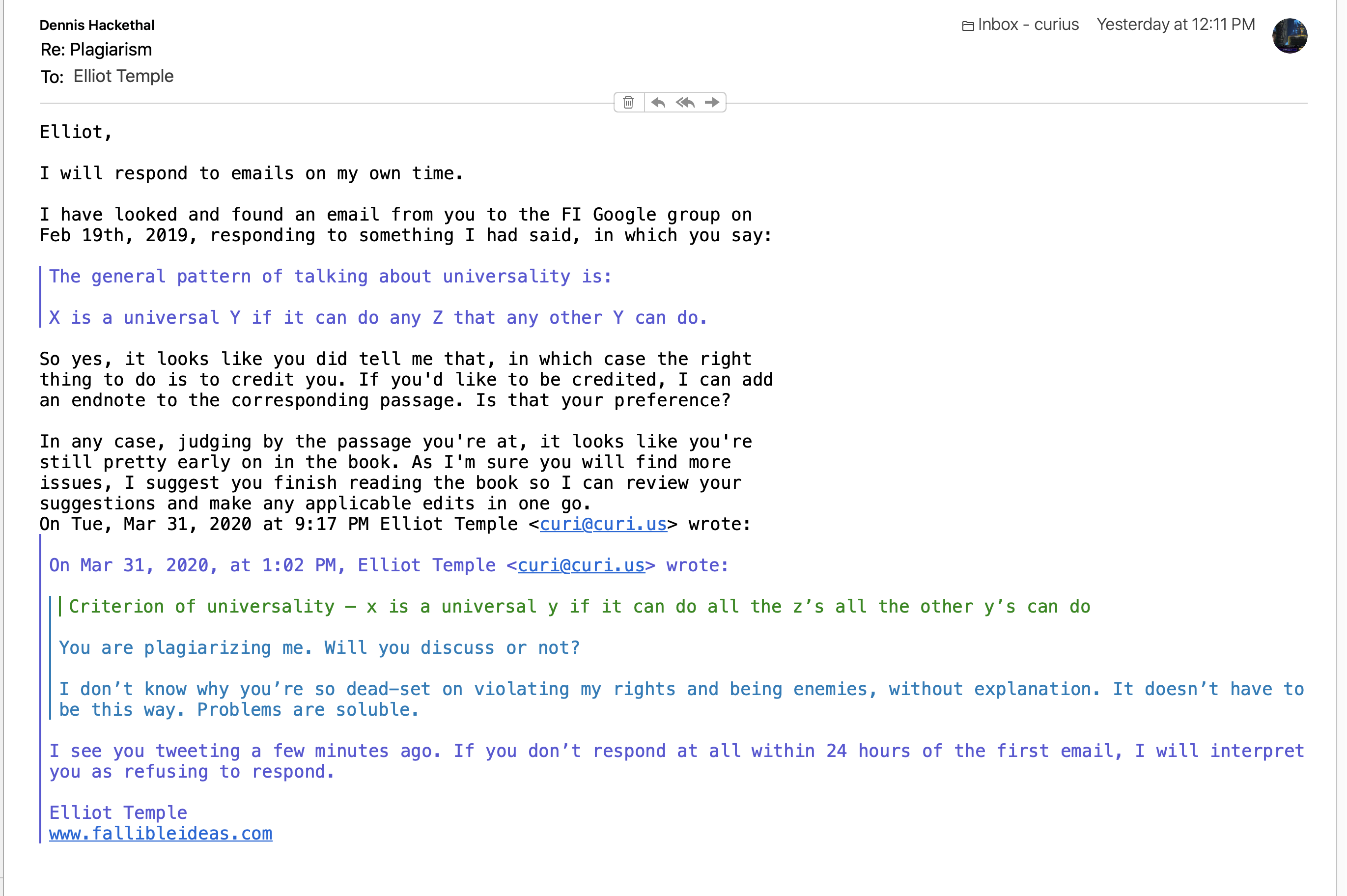
I contacted DH and brought up concerns about plagiarism when I first saw a major issue in the book: the criterion of universality sentence. He replied with what I thought was an admission of some plagiarism (yellow quotes are now from DH's emails):

yes, it looks like you did tell me that [sentence], in which case the right thing to do is to credit you.

DH then proposed adding an endnote with no mention of adding ET's name to the book or changing the sentence to use quotation marks.

judging by the passage you're at, it looks like you're still pretty early on in the book. As I'm sure you will find more issues

After I thought he acknowledged I was correct about the plagiarism I brought up, I read this as an admission that the book probably contained more plagiarism.

I suggest you finish reading the book so I can review your suggestions and make any applicable edits in one go.

I read this as DH having no plans to fix the "more issues" he was "sure" were present unless I found them for him. If he'd written the book carefully and was confident he knew how to avoid plagiarism, then I wouldn't expect him to be "sure" there were "more issues". If he isn't confident in the rest of the book, then he ought to review it and fix it himself, or if he doesn't know how to do that or doesn't want to, then withdraw it from sale.

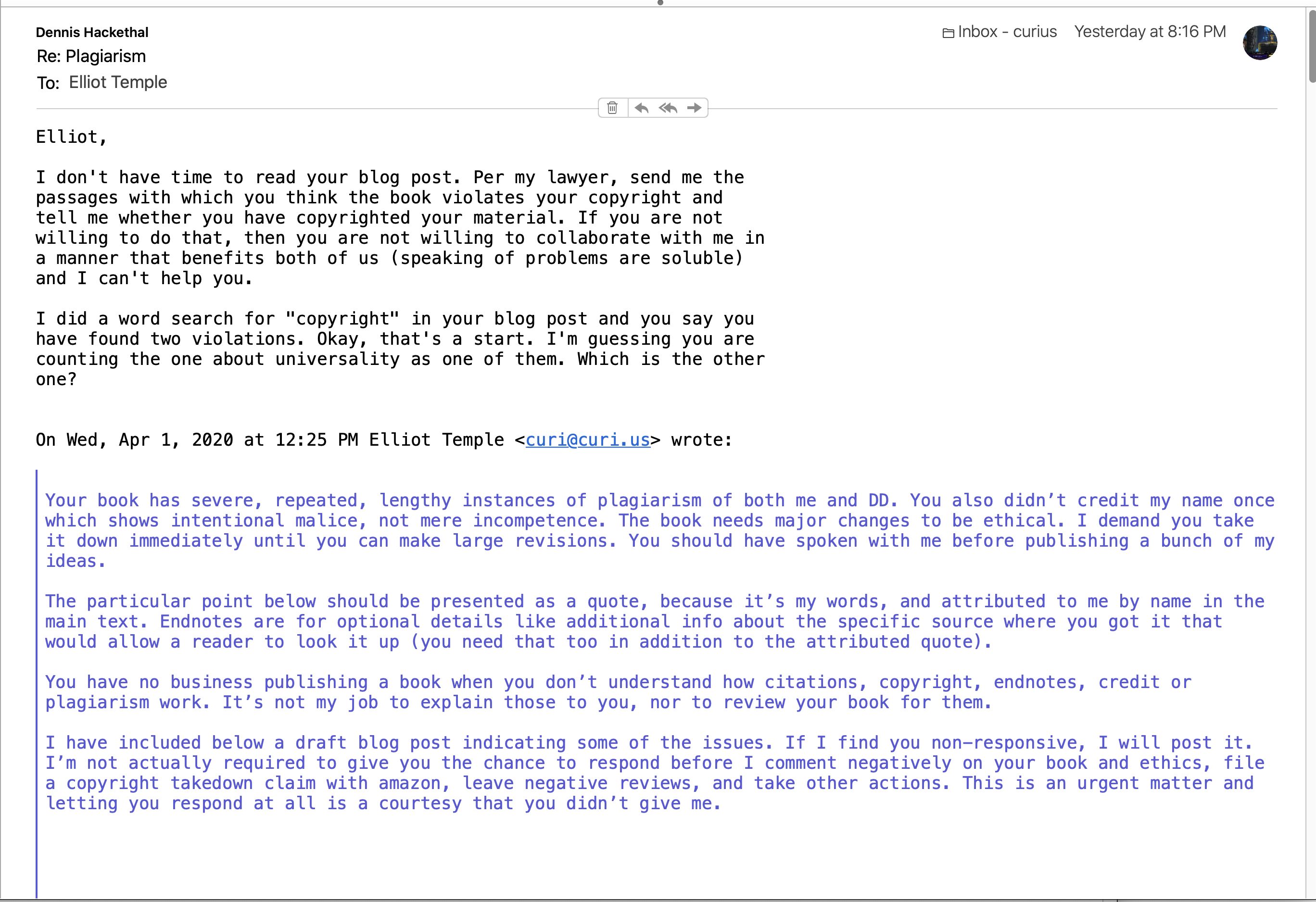
Since he wanted one long email, I sent DH a draft of this blog post. He replied:

I don't have time to read your blog post.

That seemed unreasonable to me after he had asked for one long email. I took it as him knowing he was in the wrong, having no objections to my post, and deciding to just strategically ignore me and my plagiarism complaint. I thought that he believed he could get away with plagiarizing me, and all I would do about it was write a blog post, which he could ignore, and that was worth it to him.

He also brought up his lawyer and changed the subject to copyright, not plagiarism. I replied:

You only replied about copyright. Are you saying you’re unwilling to address plagiarism issues?

DH did not reply so, given that he was ignoring me, admitted to some problems, and offered no objections to my post, I went ahead and published my post. He didn't tell me there was a problem until 2024, when he claimed that he was actually extremely upset in 2020. That implies his 2020 communications and his years of silence were misleading: it wasn't really a matter of not having time like he told me.

Here are screenshots of DH’s emails: email 1 and email 2.

DDoS

In 2020, my blog, curi.us, was DDoSed for the first time around 45 hours after I sent my draft post about plagiarism to DH, before I published it. DDoSing is a crime involving breaking websites by sending malicious information to them over the internet.

Based on the timing, I suspected the DDoS was connected with this blog post. I had questions for DH but he remained silent.

In 2024, after four years of silence, DH told me "For clarity: my denial of all criminal allegations means I did not DoS your website, nor do I know anyone who did." (I didn't call him a criminal.) He wants me to consider him a non-suspect because he belatedly said he didn't do it, even though he still won't discuss it and answer questions. And, assuming he doesn't know who did it, I don't understand how he could be confident that the perpetrator isn't someone he knows (like Andy B, who left hundreds of harassing comments on my blog).

Editing Pass

This blog post was first published on 2020-04-03. You're reading it after an editing pass in 2025. This post is still about the first edition of the book. I don't consider the second edition satisfactory, but the first edition remains relevant anyway. It was published, people own it, and DH is still defending the first edition. DH also hasn't announced or explained the second edition or provided a change log or errata, and he didn't make reasonable efforts to distribute the second edition to readers (for example, he delayed sending the update to people who'd already bought the book on Kindle for four or five years). People with a paper first edition have no way to know about any changes since Hackethal made no announcement, and anyone who already read a first edition ebook is unlikely to notice the second edition even if their copy eventually updated.

Why edit this post? The original was written quickly, with no attempt to be comprehensive, partly because I didn't want to be DH's unpaid book editor. I was unhappy about being plagiarized. Some of my rude comments were unnecessary to my main point about plagiarism. DH didn't tell me until years later that he thought this post wronged him. When I found out that he was upset, I offered to make changes, but DH declined, saying he wanted me to completely delete everything I ever wrote about him and agree to many other demands too. His threat to sue me got in the way of making changes, but I've decided to edit it anyway. It's now closer to how I'd write it today.

This version is heavily based on the original post. I made larger changes to the start and end, but smaller changes in the middle. I mostly left the same criticisms of the book in the same order. I didn't review the book to find additional concerns. I've kept this as an improved version of the original post, so I've mostly left out events from after 2020.

Conclusion

I think Dennis Hackethal's book plagiarized Elliot Temple and David Deutsch. Based on a quick review, I found problems with the book which I've shared above. Because I gave evidence and reasons, not just an assertion, you can form your own opinions and conclusions.

I request that Hackethal fix the book, share errata or some other explanation about the fixes, and make an announcement so people know about the changes – or else stop selling it. I also request that Hackethal stop reading my philosophy essays and watching my philosophy videos in order to help prevent future plagiarism.

2025 Updates

Hackethal's website, Veritula, does worse than plagiarize me. It uses my ideas but falsely attributes them to Karl Popper. He also made legal threats and attacked me online. I made a timeline.


Elliot Temple | Permalink | Messages (28)

Support My Work

Become a Fallible Ideas Subscriber to support my free philosophy work and get rewards.

Check out the subscription tiers on SubscribeStar. SubscribeStar is like Patreon but hasn't deplatformed so many people.

Available rewards include:

  • Exclusive audio and video.
  • Access to exploratory writing, research and drafts.
  • Help learning philosophy and rationality, even tutoring.
  • Your own personal curi.us discussion topic.
  • Getting questions answered privately.

Elliot Temple | Permalink | Messages (0)

Making Idea Trees

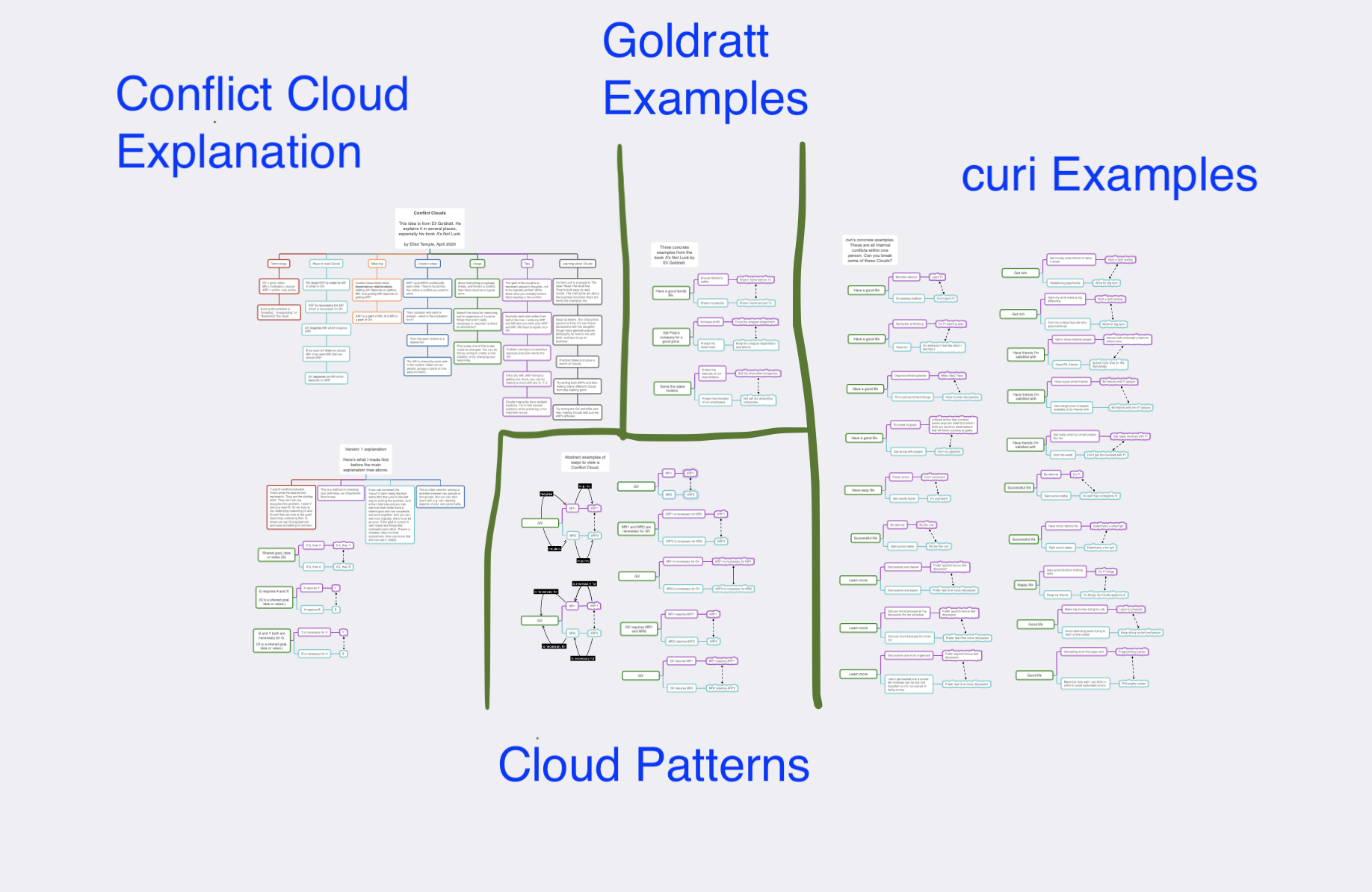
Idea Trees are a tool to help think about and organize ideas and discussions. Use them for brainstorming, outlining, project planning, debates and more. This Idea Tree teaches how to make Idea Trees:

Click the image to expand, or view the PDF which allows copy/pasting text.

More Tree Info

Discussion Tree Article

Idea Trees blog category

Discussion Trees with Example has info in the discussion below the post, too.

Tree creation software suggestions: MindNode (Mac, iOS), XMind (Windows, Mac, iOS, Android, Linux), or iThoughts (Windows, Mac, iOS). (If you can't pay, get XMind.)


Elliot Temple | Permalink | Messages (7)

Weinstein vs. Veritas

Comments on podcast: The Portal 26: James O’Keefe: What is (and isn't) Journalism in the 21st century

i listened to Eric Weinstein spend 2 hours talking to James O’Keefe (of Project Veritas) and beat around the bush the whole time. (I listened in Overcast at 2.5x or 3x base speed for different parts, with SmartSpeed automatic silence removal adding an additional speed boost too).

lots of stuff was interesting in the small picture, locally interesting, but Weinstein was supposed to be sharing his disagreement and criticism. Which was basically:

i think what you’re doing is way less effective than it could and should be because my social circle sees your name and then irrationally ignores every fact associated with it.

he never quite said that clearly, and he never really got to step 2: what specific actions should O’Keefe do differently to avoid that problem? is that the fault of O’Keefe or the social circle? what downsides would the alternative actions have?

he brought up a few specifics: he’d like O’Keefe to pixelate more faces, leave out more names, and focus more on companies/organizations not individuals.

he thinks normal people, who aren’t the problem, are scared of veritas.

O’Keefe said how body language, facial expressions, and other details help paint a more vivid picture that communicates more to people

Weinstein mentioned briefly something about how O’Keefe could start milder and escalate. like do pixelated video, then if ppl don’t care enough, release non-pixelated. this struck me as just clueless about marketing. veritas has access to limited public attention and uses it well. can’t afford extra versions (except in appendixes for ppl who want extra details). can’t just lead with something 50% effective and then try to get more attention later when ppl don’t care.

Weinstein was extremely arrogant and kept talking himself up and how advanced and smart and shit he and his audience are. He was hard to listen to. I only put up with it because i liked listening to O'Keefe.

and that was pretty much it for 2 hours.

basically Weinstein just wants O’Keefe to somehow make stuff more acceptable to Weinstein’s (bad) social circle. and O’Keefe doesn’t know how to do that without ruining it, and Weinstein had no substantive suggestions, and the social circle has bad taste.

Weinstein seems to think that maybe if O’Keefe added more appendixes explaining the tough choices he makes, and how he worries over the right actions and the balance between informing the public and avoiding hurting anyone unnecessarily ... then that would make things better. i doubt it. i think Weinstein’s social circle would come up with other complaints and excuses if some of their current ones were changed. i think he’s friends with a bunch of elite social climbers and social climbers who want to be elite, and they are invested in The System (the powers that be; the status quo cultural leaders; the power of the mainstream media; the deep state; etc) that Veritas is a threat to. I think Weinstein himself is in a mixed, confused position of disliking The System in some significant ways but also having partial allegiance to it and being friends with lots of people involved with it. He’s just confused.

I knew almost zero about Weinstein going in, just that he's Intellectual Dark Web associated. Have followed O'Keefe and Veritas for a while and like them.


Elliot Temple | Permalink | Message (1)

Fallible Ideas Community Overview

The Fallible Ideas (FI) community is for learning, philosophy, rationality and critical thinking. These can be applied to all topics (science, economics, politics, gaming, etc.), not just traditional “philosophy” topics. The central topic is how to think and learn well.

Favored thinkers at FI include Elliot Temple (aka curi, the owner), David Deutsch, Ayn Rand, Karl Popper, Ludwig von Mises and Eliyahu Goldratt.

Resources to learn about FI.

The FI community has three discussion places. They are the Curiosity website (blog/forum hybrid), the FI Google Group (email), and the Discord chatroom.

You can support Fallible Ideas with a monthly subscription. SubscribeStar is like Patreon with reward tiers. I refuse to use Patreon because of all the people they've deplatformed.

Sign up for the Fallible Ideas newsletter for 2-3 email updates per month. You'll get notifications about new articles, YouTube videos, podcasts and more.


Elliot Temple | Permalink | Messages (0)

Don't Cut Corners On Coronavirus

This post shares and comments on quotes from Hold the line, a coronavirus article by an infectious disease epidemiologist.

First, we are in the very infancy of this epidemic’s trajectory. That means even with these [social distancing] measures we will see cases and deaths continue to rise globally, nationally, and in our own communities in the coming weeks. This may lead some people to think that the social distancing measures are not working. They are. They may feel futile. They aren’t. [...] We need everyone to hold the line as the epidemic inevitably gets worse. This is not my opinion; this is the unforgiving math of epidemics for which I and my colleagues have dedicated our lives to understanding with great nuance, and this disease is no exception. I want to help the community brace for this impact. Stay strong and with solidarity knowing with absolute certainty that what you are doing is saving lives, even as people begin getting sick and dying. You may feel like giving in. Don’t.

I agree.

While social distancing decreases contact with members of society, it of course increases your contacts with group (i.e. family) members. This small and obvious fact has surprisingly profound implications on disease transmission dynamics. Study after study demonstrates that even if there is only a little bit of connection between groups (i.e. social dinners, playdates/playgrounds, etc.), the epidemic trajectory isn’t much different than if there was no measure in place. The same underlying fundamentals of disease transmission apply, and the result is that the community is left with all of the social and economic disruption but very little public health benefit. You should perceive your entire family to function as a single individual unit; if one person puts themselves at risk, everyone in the unit is at risk. Seemingly small social chains get large and complex with alarming speed. If your son visits his girlfriend, and you later sneak over for coffee with a neighbor, your neighbor is now connected to the infected office worker that your son’s girlfriend’s mother shook hands with.

This is a key point. If a family is staying home together, then if anyone in the family takes a risk, it's similar to your whole family taking the risk. That’s because one infected family member is likely to infect the rest of the family.

Also, if everyone in your family individually thinks they can get away with small risks, the risks will add up. Suppose you have 5 people each taking 3 tiny risks in a month. That's less than one risk per week. And suppose they’re 2% risks (1 in 50 odds of getting infected). Then the total risk for the family is a 26% chance of getting infected. That means over 1 in 4 families get infected from taking those tiny risks – every month. It doesn’t take many families doing this to keep the disease spreading. People acting anything like this scenario are part of the problem, not part of the solution.

In contrast to hand-washing and other personal measures, social distancing measures are not about individuals, they are about societies working in unison. These measures also take a long time to see the results. It is hard (even for me) to conceptualize how on a population level ‘one quick little get together’ can undermine the entire framework of a public health intervention, but it does. I promise you it does. I promise. I promise. I promise. You can’t cheat it. People are already itching to cheat on the social distancing precautions just a “little”- a playdate, a haircut, or picking up a needless item at the store, etc. From a transmission dynamics standpoint, this very quickly recreates a highly connected social network that undermines all of the work the community has done so far.

He's right. Don't cut corners.


Elliot Temple | Permalink | Messages (0)